
The Discipline Of Adventure

Life is either a great adventure or nothing.
Helen Keller
When I was in fifth grade, I knew exactly what I wanted to do when I grew up. I wanted to be an astronaut. I wanted to fly to the moon, around the earth, and through the solar system on the adventure of a lifetime. I remember writing to astronaut, Jack Lousma, to find out more information. He sent me a personal note along with hundreds of 8″ x 10″ photos taken by NASA photographers, and he even autographed a few of the photos for me.
When I was in college, I wrestled with the idea of becoming a full-time overseas missionary. I wanted to help people. Part of me longed for the adventure that came with this kind of pursuit, but a major part of my was terrified of the unknown related to this decision.
As I’ve become older and I’ve taken on more and more responsibility at home, at work, and at church, my sense of adventure has continued to diminish. I have become reluctant to pursue things that may be a little crazy.
Recently, I was reading Talk Like TED: The 9 Public-Speaking Secrets of the World’s Top Minds (affiliate link)
I don’t know what’s holding you back, but I think it’s time we all reconsider the discipline of adventure.
Life is too short to live in our comfort zone. We must relearn the thrill of doing something that scares us a little, that causes our heart to beat a little faster, and extends the boundaries on what we thought was possible.
You don’t have to go to the North Pole, to the moon, or to a strange land to practice the discipline of adventure (although these places may be where you end up someday). Adventure is waiting right outside your door. Get off the couch, and go do something that matters. Seek out adventure, and you might just be surprised by how much you stretch and by how much you learn about yourself.
How would your world be different if you made the decision to practice the discipline of adventure? How has adventure made a difference in your life?
The Discipline Of Focus – 5 Ways To Help You Focus

Your destiny is to fulfill those things upon which you focus most intently. So choose to keep your focus on that which is truly magnificent, beautiful, uplifting and joyful. Your life is always moving toward something.
Ralph Marston
It’s so easy to become distracted and to lose focus especially in today’s world. I was listening to a podcast the other day, and someone mentioned that the average person’s attention span is eight or nine seconds.
This means you may already have tuned out as you read this post.
WAKE UP!
Did that help?
Sometimes we need a bucket of ice water poured over our heads to get our attention.
Focus is critical to getting things done. In fact, I believe the discipline of focus is something we all must learn to practice.
John Lee Dumas has an acronym for the word focus: F.O.C.U.S. – Follow One Course Until Success
We live in a world that is clamoring for our attention. The internet is a great resource, but it also a tremendous time-waster. It’s easy to get sucked into the social media black hole of Facebook, Twitter, or elsewhere where are attention is diverted away from what really matters or from what we really want to do with our lives.
Five Ways To Help You Focus
- Determine to pursue focus. Focus doesn’t happen by accident. We’re all built differently, so focus may come easier for some. Developing the discipline of focus requires an intentional decision to pursue focus.
- Settle on your focus. There are many, many great things we can do in life, but we can’t do it all. In order to be effective, we must learn to narrow down our list of priorities. Once you decide on your focus, it will make it a lot easier to move ahead.
- Recognize your areas of distraction. Everything outside your area of focus is likely to become a distraction. Some things naturally distract us more than other things. Knowing this help you be on guard against the demons of distraction.
- Fight like mad to eliminate distraction and to stay focused. Practicing the discipline of focus is not easy. It takes courage. It takes stamina.
- Ask someone to hold you accountable to staying focused. Pursuing a goal is so much easier when we have someone cheering us on. We need people in our lives who will call us out when our focus starts to fade.
I’m going to keep this short today. Take time to practice these ways to bring more focus into your life.
How would your world be different if you made the decision to focus? How has focus made a difference in your life?
The Discipline Of Standing Up
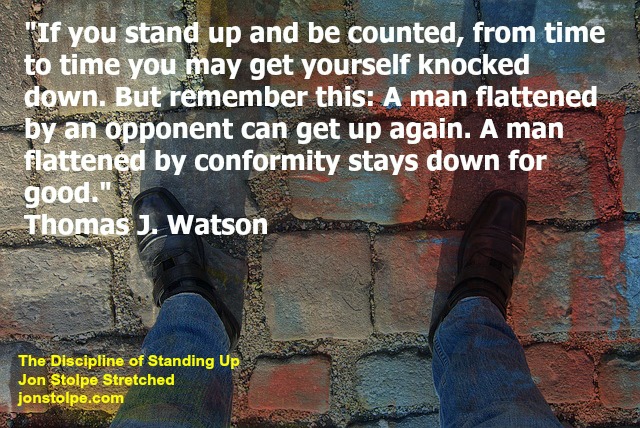
If you stand up and be counted, from time to time you may get yourself knocked down. But remember this: A man flattened by an opponent can get up again. A man flattened by conformity stays down for good.
Thomas J. Watson
I’ve been writing about discipline for the past few weeks. Why would I spend so much time focusing on disciple?
The theme of my blog is stretch. I write about things that are stretching me. I reflect on life’s stretch marks. And I hope my reflections will help others to stretch as well.
Do I have these disciplines down? By no means. In fact, these are disciplines I am challenged to work on myself. These are disciplines that cause me to stretch.
I want to keep stretching; therefore, I ponder the areas I need to cultivate in order to make the most of my life of stretch.
Over the weekend, I saw the movie Selma. I hadn’t heard a lot about the story before I watched the movie, but I was told this was a movie I needed to see. The movie portrays part of the journey of Dr. Martin Luther King and his pursuit of civil rights for African-Americans particularly the right to vote in the deep south – in towns like Selma, Alabama. Selma’s population was nearly half black, but most of this population was restricted from voting. In their efforts to stand up to this injustice, blacks were repeatedly knocked down by a white-controlled government and law enforcement.
Martin Luther King was committed to standing up against this injustice in a non-violent manner. He risked ridicule, harm to his family, and harm to his personal safety. And yet, he persisted. He stood up when “enough was enough.”
Standing up for what you believe in is easy when everyone else is on board, but it’s not so easy when you risk going against the grain of culture.
I want to fit in. I don’t want to rock the boat. I don’t want to risk disruption to my “happy” world.
It’s time to institute another discipline. We must learn to practice the discipline of standing up. We must learn to stand up when “enough is enough.”
God has given you and me a voice – a voice to stand up and speak out for things that matter.
Are you content to go along with the status quo? Or is it time for you to stand up, to speak up, and to make a difference?
These are questions we all must ponder. I don’t want to reach the end of my life and wonder if I could have done more to stand up for my beliefs. I want to know for certain that I took a stand and I rallied others for a cause that matters.
“Have I not commanded you? Be strong and courageous. Do not be afraid; do not be discouraged, for the LORD your God will be with you wherever you go.” Joshua 1:9
How would your world be different if you made the decision to practice the discipline of standing up? How has standing up made a difference in your life? What causes you to stand up?
The Discipline Of Measuring Our Lives
If you can’t measure it, you can’t manage it.
Peter Drucker
I keep track of my daily exercise on a calendar. I track my mileage. I track the amount of time I exercise. And I track the number of days I exercise as the year goes along. With these measurements, I can determine if I’m on track to meet my fitness goals. Recently, I started tracking my weight lifting on a smart phone application. This helps me remember where I am, and it helps me see growth.
I keep track of my daily devotion time. I write down the passages of scripture I read, and I take note of anything that stuck out to me. I write these things down in my journal.
I keep track of our families financial status. I keep it up to date on a spreadsheet, and I graph our progress to make sure we our on track to meet our financial goals.
I keep track of a lot of things at work. I track the performance of my team members. I track my daily schedule. I track my customers response rate and satisfaction level.
Some people might think I’m a little crazy, but I think there is something powerful about the discipline of measuring our lives.
Measurement is a process of recording what is happening in our lives. It’s the action of tracking what is going on, and it helps us see how we are being stretched.
Take time to measure what is going on around you!
How would your world be different if you made the decision to practice the discipline of measuring your life? How has measurement made a difference in your life?
The Discipline Of Boundaries

Daring to set boundaries is about having the courage to love ourselves, even when we risk disappointing others.
Brene Brown
When I arrived at work yesterday morning, I took some time to write a “To Do List” on the white board behind my computer monitors. The list helped provide a structure – a “document” – of some of the things I needed to get done yesterday. As an operations manager at my company, my days can become chaotic as I deal with the natural interruptions of helping my team members. Providing support to my team members is part of my job, and it comes with some disruption. But there are also many things I have to get done in addition to the things that come up in the spur of the moment. My white board “To Do List” is one of the tools I use to stay focused and productive throughout my day. Before I left the office last night, I erased my white board and started my “To Do List” for today.
Yesterday, one of my team members came to me for some advice (and help). He has several projects in his backlog that require his project management attention and design engineering attention. I remember the feelings I had when I was in a similar position many years ago. I often thought “Where do I start?” and “How do I keep all these plates spinning?” My team member constantly gets phone calls from customers and installation staff with “urgent” requests for assistance. This is a problem many project managers face, and the problem has only gotten worse in today’s “Gotta Have It Now” world where we are all connected instantaneously through smart phones and email. We have conditioned our customers to expect an immediate response. This isn’t all together bad. After all, we want to bring a superior level of customer service to our customer base. However, without appropriate boundaries, we set ourselves up for failure. We will never accomplish the important things, because we are busy attending to the urgent things.
You may disagree with me, but I suggested to my team member that he shut his email and his phone off for a period of time to focus on some of the things on his “To Do List” that needed attention. Before lunch and before the close of the day, he can turn them back on to check in on any messages that he may have received. This will give him the chance to get work done and then to address any “urgent” needs of his customers.
We all need boundaries in our lives. As a matter of fact, I would suggest we need to practice the discipline of boundaries in our daily lives. Boundaries mean thinking through the list of goals you have and creating fences around your time and your commitments to make sure you can hit these goals. Boundaries also protect us from going to unhealthy places in our lives.
I would challenge you to consider what boundaries you need to set in your life. What needs to go? What needs to stay?
How would your world be different if you made the decision to practice the discipline of boundaries? How have boundaries made a difference in your life?
The Discipline of Laughter – 4 Ways To Develop The Discipline Of Laughter

A day without laughter is a day wasted.
Charlie Chaplin
Life can be challenging. In fact, life can be downright depressing.
We have bills to pay. We have deadlines to hit. We have demands crushing us in from every side. With all this pressure, it sometimes seems as though it would be easier to crawl in a corner and give up.
But we are called to so much more.
Life has so much to offer us if we learn to smile, if we learn to laugh, and if we learn to push ahead with a positive attitude.
I’ve always been known as a pretty serious individual. I admittedly don’t smile enough. I too often have tunnel vision on what I’m trying to accomplish (or what I’m trying to get through). The interesting thing is that I also have a sense of humor. I’d like to think it comes through my Grandpa Stolpe who also had a corny sense of humor.
Humor is a good thing. We all need to laugh.
Developing the discipline of laughter is important to seeing the bright side of every obstacle. It’s important to help us through when we can’t carry on. And it’s good for the soul.
Proverbs 17:22 says:
“A cheerful heart is good medicine, but a crushed spirit dries up the bones.”
I don’t know what you are going through, but I’m guessing you could use some laughter in your life. Here are some ways to develop the discipline of laughter in your life:
4 Ways To Develop The Discipline Of Laughter
- Enjoy a funny movie or funny television show from time to time. There are so many great comedies out there that will bring a smile to your face. Here are some of my favorites: Grumpier Old Men, Mrs. Doubtfire, Happy Gilmore, Cheers, and Bill & Ted’s Excellent Adventure. What funny movies or television shows make you laugh?
- Attend a stand-up comedy night. I’ve gone to a few of these, and they make me role. One word of caution, some of the comedy can be pretty raunchy, so be careful with which comedy night you decide to attend. I’ve attended a couple of these nights with Michael Jr., Tim Hawkins, and Gabriel Iglesias.
- Hang out with friends who make you laugh. There are friends who drag you down, and there are friends who lift you up. Choose wisely, and make a habit of hanging around with friends who encourage you to laugh.
- Watch other people. People do and say the funniest things. Sit on a bench in the mall. Attend a kids sporting event. Learn to observe what is going on around you. You will learn, and you will laugh.
How would your world be different if you made the decision to practice the discipline of laughter? How has laughter made a difference in your life?
The Discipline Of Taking Inventory On Our Lives

We have so much room for improvement. Every aspect of our lives must be subjected to an inventory… of how we are taking responsibility.
Nancy Pelosi
In fifteen days, I will be leaving for my annual pilgrimage to the Poconos with a few of my friends. This is a tradition I have been keeping for over twenty years. Each year about this time, I start reviewing my packing list. I start with last year’s spreadsheet. I erase the things I didn’t need last year, and I add new things that I think will be useful this year. One of the things on my list is my tackle box. This week, I’ll be doing inventory on my fishing gear. I’ll take the opportunity to throw out a few items, and I’ll consider a few fishing lures and accessories that I think will enhance my fishing experience on this year’s trip.
Taking inventory on my fishing gear reminds me about another important stretching discipline.
It’s important to do inventory from time to time in our lives.
The discipline of taking inventory on our lives is a healthy opportunity to analyze our priorities, to consider our past, and to reset our vision for the future.
Many of us reserve this discipline for the new year (in late December or early January), but this is a discipline we need to practice with greater frequency.
I challenge you to take inventory on your season each quarter. I challenge you to take inventory on your month every month. I challenge you to take inventory on your week each weekend. And I challenge you to take inventory on your day at the end or beginning of each day.
Teach us to number our days, that we may gain a heart of wisdom. Psalm 90:12 (NIV)
If I could rephrase this verse, it would say: We should practice the daily discipline of taking inventory on our lives, so we can stretch ourselves and grow in wisdom.
How would your world be different if you made the decision to practice the discipline of taking inventory on your life? How has taking inventory on your life made a difference in your life?
The Discipline Of Rest – For When You Feel Weary

Rest when you’re weary. Refresh and renew yourself, your body, your mind, your spirit. Then get back to work.
Ralph Marston
I came home last night from work, and I felt weary.
Do you ever feel this way?
Weariness happens in this human life. We all deal with it from time to time. Part of it comes from our own misguided efforts to climb the ladder or to keep up with the Jones’. And some of it comes from the trials and tribulations of life.
Whatever the case may be, I think we must take time to refresh and renew ourselves. We must learn the discipline of rest. For only when we rest (and find true rest in the Completer of Life) can we overcome weariness in our pursuit of stretching and in our pursuit of becoming effective – effective leaders, effective employees, effective friends, and effective family members.
As I was thinking about the subject of weariness, these passages came to mind. May they encourage you to have hope when the weariness of life has you down.
He gives strength to the weary and increases the power of the weak. Even youths grow tired and weary, and young men stumble and fall; but those who hope in the Lord will renew their strength. They will soar on wings like eagles; they will run and not grow weary, they will walk and not be faint. Isaiah 40:29-31
” I will refresh the weary and satisfy the faint.” Jeremiah 31:25
“Come to me, all you who are weary and burdened, and I will give you rest. Take my yoke upon you and learn from me, for I am gentle and humble in heart, and you will find rest for your souls. For my yoke is easy and my burden is light.” Matthew 11:28-30
Let us not become weary in doing good, for at the proper time we will reap a harvest if we do not give up. Galatians 6:9
How would your world be different if you made the decision to practice the discipline of rest? How has resting made a difference in your life?
How Discipline Helps Keep You Going When You Feel Like Giving Up

Good habits formed at youth make all the difference.
Aristotle
I had every intention of sleeping in last Thursday morning. I’ve been getting up every day at 4:00 AM for a while (on weekdays). I’m typically at the gym by 5:00 AM. When I went to bed Wednesday night, I set my alarm clock back to 5:15 AM, so I could sleep in a while 75 minutes.
I wish I could tell you my internal alarm clock did the same thing. At 4:00 AM, I was wide awake. I looked at the clock and tried to go back to sleep. It didn’t work. At 4:30 AM, I was still awake, and I thought to myself, “No one is going to go to the gym for me. If I don’t go someone else is getting ahead of me.”
This is where discipline kicks in. Even when you feel like giving up or just taking a break, discipline spurs you on. It reminds you to keep going, and it even carries you when you feel like you can’t do it anymore.
When you consider the disciplines or habits you want to keep, consider wisely. These decisions along with your initial willingness to act will carry you along the journey of life.
Choose your rut wisely, because you will be in it for a long, long, time.
Choose disciplines for your life that will stretch you and help you grow.
What disciplines do you need to develop in your life? What disciplines in your life have helped you grow? How have you seen disciplines or habits carry you when you didn’t feel like moving forward?
The Discipline Of Taking Risks

Only those who will risk going too far can possibly find out how far one can go.
T. S. Eliot
When was the last time you took a risk?
What ultimately led to you taking the risk?
I don’t know about you, but I’m not a big risk taker. In fact, my natural inclination away from risk seems to grow more and more as I age.
I was listening to a podcast the other day, and someone said “The biggest risk is not taking a risk.”
Do you agree or disagree with this statement?
Being risky doesn’t have to mean doing something stupid, but it does mean getting outside your comfort zone. It could mean taking a calculated risk. According to dictionary.com, a calculated risk is:
a chance of failure, the probability of which is estimated before some action is undertaken.
This type of risk requires discipline. If we don’t learn to take calculated risks from time to time we will live a life of regret and wonderment. We’ll be left to wonder what could have been.
Three years ago, I was imprisoned by a fear of failure and a fear of the unknown. I missed out on many opportunities because I lacked the courage and faith to step into the unknown. This is about the time my friend, Adam Flora, asked me to join him on a missions trip to Guatemala. It would have been much easier to simply say “no” than to go through the anxiety of saying yes and worrying about the potential outcomes.
Fortunately, I decided to take the risk. I calculated the chance of failure, and I made the leap of faith to go along on the adventure of a lifetime. This trip changed my perspective on short-term missions, on Guatemala, and on the importance discipline of taking risks.
Several years ago, Jason Fountain guest posted on my blog, and he shared an interested story in his post. Here’s an excerpt from that post:
John Maxwell relates a story shared by sociologist Anthony Campolo. Campolo tells about a group of 50 people over the age of 90 years old who were asked one question: If you could live your life over again, what would you do differently?
The question was open-ended and the people’s answers were varied. However, three ideas consistently emerged.
1. If I had it to do over again, I would reflect more.
2. If I had it to do over again, I would risk more.
3. If I had it to do over again, I would do more things that would live on after I am dead.
Number two on this list was all about risk. As I watch my daughter preparing for college, I am reminded how quickly life moves forward. I don’t know about you, but I don’t want to end up like the people in Tony Campolo’s survey. When I get to the end of my life, I want to know for certain I lived my life to the fullest. While it may stretch me, I want to practice the discipline of taking risks.
How about you?
How would your world be different if you made the decision to practice the discipline of taking risks? How has risk-taking made a difference in your life?