
The Discipline Of Pressing On (Even When You Feel Uninspired)

Press forward. Do not stop, do not linger in your journey, but strive for the mark set before you.
George Whitefield
I almost skipped today.
I almost didn’t post on my blog today.
Life has been pretty busy lately, and I honestly didn’t feel all that inspired.
At work, I am in the midst of closing down our fiscal year which means I’ve been busy closing projects and making sure our financials are in order by September 30th. At home, I am just as busy. Our kids are very active (which is a good thing), but it often means I’m on the road at a cross-country meet, a football game, or a marching band show. I’m also helping my wife as she works on building her life coaching business.
All these things are great, but I sometimes feel drained. And there are times when I leave little margin for reflection and inspiration.
All this to say, I come to the keyboard today feeling a little worn out and a lot uninspired.
And yet, I’m sitting here writing my post for today. I’m pressing on even when I don’t feel like it.
Why?
Some think I should just skip the day and wait for new inspiration tomorrow. But I’ve learned that this isn’t necessarily the best choice. I’ve learned that practicing the discipline of pressing on despite lack of inspiration and motivation is the best way to get the results I want.
I’ve finished three marathons and several half marathons. In training for these races, I’ve learned to press on when it comes to my daily training runs. One skipped training day would lead to another and another, and I would have arrived at the starting line unprepared.
I wrote a book. The book didn’t write itself, and it didn’t come together in one day. Writing the book took days and weeks of writing. I had to write even when I didn’t feel like it in order to meet my goal.
My wife and I have raised two children. We don’t always get it right when it comes to parenting, and they aren’t perfect kids. But they are pretty good! This doesn’t happen if we decide to take a break from parenting when we don’t feel like it.
Pressing on inches us closer to “the prize.” I don’t know what prize you are pursuing, but it won’t happen if you don’t persist.
This is why I am writing today’s post. I’m pressing on, because I’ve seen the benefit of daily blogging. And I’m confident I’ll see more results because I decided to press on even when my inspiration wasn’t all there.
What “prize” are you pursuing? What keeps you going when you don’t feel inspired?
How would your world be different if you made the decision to practice the discipline of pressing on? How has persistence despite lack of inspiration made a difference in your life?
(Maybe I was a little more inspired than I thought. I think the inspiration came as a result of pressing on.)
The Discipline Of Self Assessment – 10 Areas For Self Assessment

Confront the dark parts of yourself, and work to banish them with illumination and forgiveness. Your willingness to wrestle with your demons will cause your angels to sing.
August Wilson
As I mentioned yesterday, my basement flooded.
The first step in dealing with a flooded basement is understanding what caused the water problem. Both of my sump pumps were working, but they obviously couldn’t keep up. Why was water coming into the basement more quickly than it should? The rain earlier in the day had been very heavy, but the pumps should have kept up.
When I walked around the outside of the house, I discovered that one of the downspouts at the back corner of the house was not attached correctly. This was causing a large amount of water to flow straight into the foundation. I fixed the downspout, but the damage was already done.
Had I walked around the house before the rainstorm, I would have noticed the problem, and I would not have been dealing with a wet basement.
As I have been reflecting on this experience, I was reminded of the importance of taking a regular inventory of our lives. Regular self assessment gives us an opportunity to see where we are – to see what things are okay, what things could be better, what things need to change, and what things need to be removed.
By practicing the discipline of self assessment, we minimize the potential for disaster, and we maximize the potential for achieving future success. Here are some areas where you should be conducting a regular self assessment:
10 Areas For Self Assessment
- Personal property. What do you own? Car, house, computer, jewelry. Things wear out, break down, and need maintenance. Regularly examine your personal property to make sure it is in working order.
- Career path. When was the last time you updated your resume? Are you making progress towards your career goals? Career growth does not happen by accident. You must be intentional if you want to move forward along your desired career path.
- Educational pursuit. Are you feeding mind? And are you feeding it with the right material? Read. Listen. Grow.
- Physical fitness. Are you being a good steward of your body? Take time to assess your nutrition, your exercise, and your overall fitness.
- Financial fitness. Take time to budget. Take time to keep track of your financial condition. Are you on track to meet your long-term goals. Get rid of debt in your life, and find ways to save.
- Emotional condition. How is your general attitude? Are you a happy person? Or are you a grumpy person? Attitude often determines our altitude. If you want to go somewhere in your life, learn how to be a positive person.
- Relational status. How is your marriage? How is your relationship with your kids? How is your relationship with your family and friends? Relationships require effort, and they change throughout time. For this reason, you must regularly assess these relationships. If your marriage is going well, determine what is helping this and keep doing it. If your marriage needs some work based on your assessment, make changes today to improve it.
- Generosity. Are you giving away your time, talents, and money? Are you giving away too much or too little? A regular assessment of your generosity will keep you on the right track to living a life that really matters.
- Time. Sit down with your schedule on a regular basis. Are you building margin into your schedule? Are you spending time on things that matter? How are you wasting your time? A regular assessment of your time is essential avoiding burnout and boredom.
- Spiritual well-being. How is your spirit? How are you feeding your spiritual self? How is your relationship with God? In our busy lives, it’s too easy to let our spiritual well-being take a back seat. When you are assessing your life, don’t forget to take an inventory on your spiritual life.
Self assessment won’t happen or be effective unless you take it seriously. Create a routine for taking an inventory on these areas of your life. Some things require daily assessment. For other things you might check in weekly, monthly, seasonally, or annually.
Don’t miss out on an opportunity to prevent a flood in your basement or to prevent another kind of disaster in your life. Decide today to practice the discipline of self assessment.
How would your world be different if you made the decision to practice the discipline of self assessment? How has self assessment made a difference in your life?
The Discipline Of Getting Feedback – 6 Steps For Getting The Feedback You Really Need

It’s impossible to read the label when you are inside the bottle. You need somebody to speak into your life – someone who will read the label and tell you what is really on the inside.
Do you like getting feedback from others?
What kind of feedback do you like?
What kind of feedback do you really need?
Are you surrounding yourself with people who will tell you what you need to hear instead of what you want to hear?
Stretching can be painful, and getting feedback from others can be a stretching experience. And yet feedback is what we often need in order to grow – in order to recognize our gifts and shortcomings – and in order to live our life to the fullest.
With this in mind, I think it’s time we start practicing the discipline of getting feedback.
Today, I need your feedback, but first I want to give you some advice on practicing the discipline of getting feedback. By using these six steps, you will keep stretching in a worthwhile direction.
6 Steps For Getting The Feedback You Really Need
- Open up your mind and heart. Do you really want to stretch and grow? Are you really willing to listen to feedback even when it is hard to hear? Before you even ask for feedback, you have to decide to be open to what you will hear from others. Some feedback will be easy to hear. And some feedback will be very difficult to process.
- Ask people you trust. Asking foolish people for feedback is like inviting people to throw tomatoes at you for the fun of throwing tomatoes. But there is wisdom to be gained from those you can trust.
- Examine the feedback. Once you’ve received feedback from others, it’s important to evaluate the feedback. Run it by others to see if the feedback is on target. What feedback deserves attention, and what feedback should you ignore?
- Filter out any off base feedback. Once you’ve examined the feedback, get rid of the off base feedback. Feedback that misses the mark will lead you to the wrong target if you decide to listen to it.
- Take action on justified feedback. Whatever is pure, trustworthy, and just deserves our attention. Take corrective action on constructive feedback. Continue to act on the things you are doing well, and stop doing the things you need to stop. Make the necessary changes based on the feedback you receive (otherwise, you are wasting the time of those giving feedback).
- Repeat the process. Asking for feedback is not a once and done event. Getting feedback is an endless process that should be followed again and again. So go back to step one and start it all over.
Now that I’ve laid out these six steps for getting the feedback you really need, it’s my turn to ask for your feedback.
I’m in the process of evaluating my writing focus and I really need your help. I am going through this exercise to help me stretch and to help others stretch. I started this process by asking myself to write down the names of 20 people who I think could truly, genuinely benefit from what I have to say. I filled a page in my journal with these names. Then I spent time considering the most common questions people ask me. Here are a few of the questions that came to my mind:
- How do you have time to do everything you do? (And when do you sleep?)
- When are you going back to Guatemala? (And can I come?)
- How did you and your wife raise such great kids?
- When is your next book coming out?
- How did you get into that (home-brewing, chicken-farming, blog-writing, etc.)?
- Do you have any advice for long distance running?
- How do you stay so positive all the time?
- Can you be my mentor?
- How do you stay so consistent?
- What have you done to get to where you are now (and what do I need to do to get there myself)?
- How do you live out your faith in a faithless, fallen world?
To confirm I’m on the right track (or to add to the list), I have been intentionally asking the 20 people on my life (and a few other people) to give me feedback. I’ve been asking them this question: “If you could ask me any question, what would the question be? In what area of my experience do you think I could help you?”
It’s a little scary to ask these questions, but it’s an experience I need to have. I need this feedback to make sure I am on the right track. I need this feedback to help me see what is on the inside of my bottle.
And it’s feedback I need from you as well. I value your feedback as a reader and participant in The Stretched Community. And so, I leave you with this question, and I hope you will take time to leave me a comment. I need you to help read the label on my bottle.
If you could ask me any question, what would the question be? In what area of my experience do you think I could help you?
Please take time to leave your response in the comments.
The Discipline Of Mastermind

If you find you are weak in persistence, surround yourself with a Mastermind Group.
Napolean Hill (Think and Grow Rich)
Nearly a year ago, I started meeting with 13 other guys on a weekly basis. Every Friday morning at 6AM, we gather in someone’s basement for an hour-long conversation. Sometimes the weekly discussion centers around the chapter of a book. Sometimes we talk about a hot topic. Sometimes we spent time dealing with a struggle that one of us is going through. For fourteen weeks, we spent time getting to know each other (one week for each of us). When we started meeting together, we committed to meet together for the next twenty years. A year later, the group is still in tact. 19 more years until we reach our goal!
For me, the group has meant many things. Mostly, it is a place to spur each other on. The writer of Hebrews challenges readers in chapter 10:24-25:
And let us consider how we may spur one another on (STRETCH each other) toward love and good deeds, not giving up meeting together, as some are in the habit of doing, but encouraging one another—and all the more as you see the Day approaching.
I find tremendous encouragement through our weekly meetings. These guys STRETCH me.
The group is a mastermind of men who are trying to become better husbands, better fathers, better workers, and better friends. We are also trying to grow and learn in our relationship with Christ.
Dictionary.com defines mastermind as follows:
1.
to plan and direct (a usually complex project or activity), especially skillfully:
Two colonels had masterminded the revolt.
2.
a person who originates or is primarily responsible for the execution of a particular idea, project, or the like:
the masterminds of company policy.
We want our group to help us intentionally grow. We are attempting to skillfully plan and direct our growth.
Real, consistent growth does not happen by accident. Growth (or stretching as I like to call it) happens when we practice the discipline of mastermind – the discipline of skillfully planning and directing our lives.
What do you want to accomplish in your life? What are you doing about it?
I think we could all use a mastermind group (or two or three) in our lives to help us strategically go after our calling.
This week, I am stepping into a new mastermind group with a few other people from around the country (Georgia, Texas, and Washington). We will be meeting bi-weekly for the next six months. We are all working on writing, speaking, podcasting, and other endeavors, and the group is designed to help us skillfully plan and direct our next steps. For me, this group will help me focus on the next steps in my writing and speaking journey.
I didn’t sign up for this group because I needed something else to fill my calendar. I signed up for this mastermind group, because I want to keep stretching, and I want to help others stretch.
We need others to speak into our lives, and they need us to be there for them. A mastermind group is a great place to intentionally fulfill both of these needs. Maybe you won’t call it a mastermind group, but you need others in your life. You need to be part of a community that will spur you on and stretch you. What are you waiting for?
How would your world be different if you made the decision to practice the discipline of mastermind? How has a mastermind group made a difference in your life?
The Discipline Of Going The Extra Mile – 6 Ways To Go The Extra Mile

There are no traffic jams along the extra mile.
Roger Staubach
We are in the process of college shopping with our oldest child, Hannah. She is getting ready to start her senior year in high school, and we have spent several long weekends this summer visiting colleges.
A couple of week’s ago, we visited Grove City College which is located in Western Pennsylvania. Hannah had an interview with the admissions department, and she met with the track and cross-country coaches.
 As we were planning for this visit a few weeks prior to our trip across the state of Pennsylvania, my brother and sister-in-law reached out to us about meeting us in Grove City for the weekend. They live in Milwaukee, Wisconsin which means they were committing to ten hours (or more) of driving each way just to spend a day or two with our family.
We reserved a couple of rooms at a hotel halfway between Grove City and Pittsburgh, and we spent time together playing games, swimming in the pool, visiting Pittsburgh, and hanging out.
They arrived late Friday night, and we left around noon on Sunday to return home. The visit was short, but it was something I won’t forget.
My brother and his family decided to drive over twenty hours, pay for tolls, hotel, and food, and miss out on a weekend of activities at their own home just to spend time with us. Their willingness to go the extra mile meant the world to me.
Their visit reminded me that we need to cultivate the discipline of going the extra mile.
Going the extra mile means taking the extra effort. It means going two miles with someone when they ask you to go one mile. Going the extra mile shows people you really care. And it can mean the difference between good and great – in your job performance, in your extra curricular activities, and in your relationships.
If you’re having trouble getting started with this discipline, here are some ideas to help you go the extra mile:
6 Ways To Go The Extra Mile
- Be alert and take action in your daily life. What do you see? What drives you crazy? And what are you doing about it? It drives me crazy when I see trash on the floor and when I see grumpy people in my daily life. I have the opportunity to practice the discipline of going the extra mile when I come upon these things. I can pick up the trash instead of waiting for someone else to take care of it. I can take time to listen to unhappy people I encounter at work. These simple responses are an opportunity to go the extra mile. You have similar opportunities around you each and every day.
- Don’t wait for the ask. Don’t be reactive. Become proactive. As you practice this discipline, it will become more and more natural. You won’t need the prodding of others to get you started.
- Don’t look for accolades. We give GEMs at our office for people who have “gone the extra mile.” These awards are away to say thank you, and they are great. But our motive for going the extra mile should not be about being recognized or about receiving an award. The discipline of going the extra mile is about doing the right thing even when no one is watching.
- Find ways to put a special touch on it. Be creative. The discipline of going the extra mile may require some mental and physical energy. Leave tips. Find creative ways to say thank you. Make others feel valued. By going the extra mile, you have the opportunity to help others know they are special.
- Partner with others. The discipline of going the extra mile is always better when you practice it with others. By inviting others to join you in this discipline, you will have the opportunity to encourage each other and hold each other accountable. I meet with a group of men every week in hopes that they will spur me on to go the extra mile.
- Make the sacrifice. If you really take this discipline seriously, you will have to sacrifice your time, your energy, and your resources. When you go the extra mile, you will discover that the sacrifice is worth it.
When was the last time you observed someone going the extra mile?
How would your world be different if you made the decision to practice the discipline of going the extra mile? How has going the extra mile made a difference in your life?
The Discipline Of Less
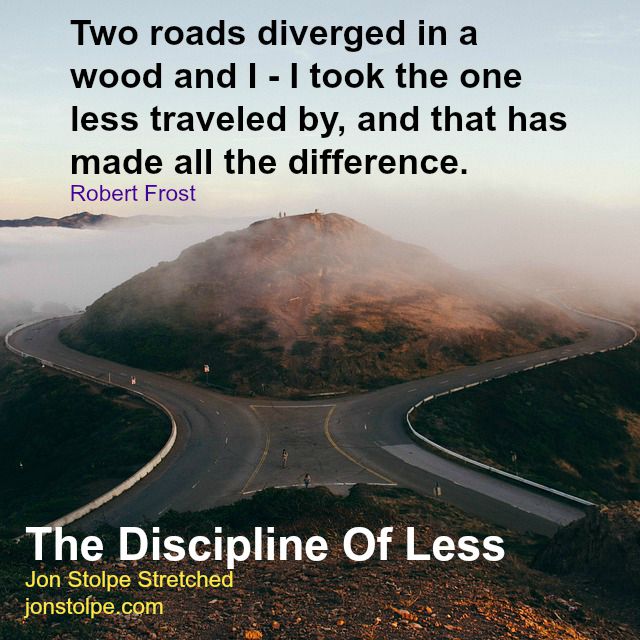
Two roads diverged in a wood and I – I took the one less traveled by, and that has made all the difference.
Robert Frost
When I was growing up, I collected stamps and baseball cards. I still have my stamp collection, and I inherited part of my Grandpa Stolpe’s stamp collection. I also still have my baseball card collection. In all, I have over 30,000 baseball cards. I haven’t added to either collection in years. I’ve lost interest, and my spending priorities have dramatically changed since getting married and having children.
I remember doing everything I could to get more baseball cards. I bought bubblegum packs at the local 7-Eleven store at the edge of my neighborhood in Lumberton, NJ. I bought triple packs at Woolworth’s in Mt. Holly, NJ. I traded cards with friends, and I worked hard to accumulate more and more cards to complete the set of cards for the year.
An annual Topps baseball card set consisted of 792 cards when I was growing up. I opened each pack, and looked at each card hoping to find a star player or a card I needed to complete my set. I turned over the card and read the information about the baseball player pictured on the front of the card. Then I sorted the cards. First, I’d sort the cards into hundreds. Then I would take each stack of hundreds and sort them into piles of tens. I would insert the cards I still needed into my set, and I’d add any doubles into another box which I would use to trade with my friends.
My obsession with gathering more and more baseball cards for my collection grew and grew through high school. In college, this obsession began to shift as I focused more on my studies and the next stage of my life.
I stopped gathering baseball cards, and I started gathering CDs (these are the round metal things that used to contain music for playing in a compact disc player). I wanted to keep up with my brother, my college friends, and others who were also collecting CDs. For a while, I couldn’t get enough CDs. I had to have the latest album from U2, R.E.M., Billy Joel, They Might Be Giants, DC Talk, Stephen Curtis Chapman, The Kry, and others. I remember visiting the local music store with my friend, John Kosydar, as we both searched for the next set of CDs to add to our collections. One CD was not enough. I had to have more.
Eventually, I outgrew this obsession, and I switched to bigger, more expensive pursuits like cars, houses, and vacations.
More! More! More!
After pursuing these things, I have come to realize these things don’t really satisfy. In fact, they leave me feeling empty. My baseball cards sit in my house gathering dust. My CDs are filed away rarely getting played. My cars and house wear out.
My pursuit of more is clearly misdirected. And I’m sure I’m not alone.
What are you pursing? What obsession has your attention?
In considering disciplines worth following, I think it’s time we start looking at the discipline of less.
My friend, Dan Erickson, writes about the simple life on his blog – hipdiggs.com. After his own failed efforts to find happiness by pursuing stuff, he has made a shift. Dan has decided to simplify his life by becoming a minimalist. Instead of accumulating stuff, Dan is accumulating relationships with his daughter, with his students, with his neighbors, and with his friends in the blog world. Dan seems to be practicing the discipline of less, and I think we could all learn a thing or two by taking a page out of his book.
The discipline of less actually provides more time, energy, and resources for the things that matter.
They say “Less is more.” There’s only one way to find out if it’s true. I challenge you to find out for yourself by taking up the discipline of less starting TODAY!
What are you holding onto that needs to go?
How would your life change if you practiced the discipline of less? What is one thing you can do TODAY to shed the weight of things that don’t matter in the end?
What good will it be for someone to gain the whole world, yet forfeit their soul? Or what can anyone give in exchange for their soul?
Matthew 16:26
The Long Walk

He has shown you, O man, what is good. And what does the LORD require of you? To act justly and to love mercy and to walk humbly with your God.
Micah 6:8
For the past couple of months, I have been taking a walk in the early morning hours. The walk helps me wake up, but it also helps me to get my head and heart in the right place as I start my day. Usually during this time, I listen to the Daily Audio Bible Podcast with Brian Hardin as I’m walking along the streets of my neighborhood. Each day, Brian reads a passage from the Old Testament, a passage from the New Testament, a part from Psalms, and a verse or two from Proverbs.
I’ve been listening to the podcast for a few years, and I appreciate the opportunity to walk through scriptures each year with the “Daily Audio Bible Community.”
Today marks a special day for this community. On July 7th for the past several years, listeners from all over the world take time today to take a long walk. Brian lays out some thoughts about The Long Walk on the podcast website. He encourages participants to take the day off to intentionally walk with God.
I won’t be taking the whole day off today, but I will be using my morning walk to intentionally connect with God. In fact, it’s my intent to forgo my time at the gym to take an extra long walk today.
God is always walking with us, but the walk is so much better when we intentionally unplug from the distractions of life so we can plug into God.
I’d encourage you to join others from around the world by taking time to walk with God today.
How do you intentionally connect with God? Are you up for a long walk today? If so, tell me about your experience in the comments.
Small Steps To Big Leaps – Getting Outside Our Comfort Zones

We keep moving forward, opening new doors, and doing new things, because we’re curious and curiosity keeps leading us down new paths.
Walt Disney
I consider myself to be fairly athletic. I can hold my own on the basketball court, the football field, the baseball diamond, and the bowling alley. I even do well in the swimming pool. I can post up a player or block a shot in a basketball game thanks to my height. I love running a fade pattern to the corner of the end zone while playing a game of pickup football. I can hit a line drive up the middle for a single. And with a little practice, I’m pretty sure I could bowl over 200 again.
Despite my athletic abilities, I am terrible when it comes to board sports. I can’t skate board. I’m fairly shaky on snow skis and water skis. And ice skating and roller skating are just as bad. Part of it has to do with my high center of gravity. When I fall, it’s a long way down and a painful landing.
Needless to say, I’m more than a little timid when it comes to trying any kind of new board sports.
Have you ever been scared to try something new?
Maybe your past experiences have left you feeling hesitant to cross the boundaries of your comfort zone. Your fears and anxieties may be preventing you from having the time of your life.
I went to Ocean City, Maryland this weekend with my family to relax and spend time with some good friends. The weekend included many memorable moments.
My friend, John, has a paddle board, and he was insistent that I give it a try.
A paddle board looks like a long, wide surfboard. Riders stand on the board and use a long paddle to maneuver the board through the water. Balance is essential to successfully staying on the board.
I watched him try it first. Then I encouraged my younger and more agile daughter to give it a try, and she did a great job navigating the calm waters of the lagoon behind John’s house.
Next, it was my turn. I voiced my concern about trying this new thing. The sight of jellyfish in the lagoon did not do a lot to comfort me as I considered the strong possibility of me joining them in the water below the paddle board. Nonetheless, I had to give it a try.
I found my way from the dock to the board, and I quickly started to tip the board. I sat back down on the dock for a moment to reconsider my decision. I decided to give it another try, and I stood back up on the board. I gently pushed away from the dock, and I felt my legs shaking as I tried to stay on the right side of the paddle board. I made a small circle, and tried to come back to the dock, but John wouldn’t let me. I looped around again, and I went a little further out into the lagoon. Before I knew it, I was standing up a little straighter, and I was beginning to lift my head up so I could enjoy the view. I stayed out in the lagoon for ten or fifteen minutes (maybe it was only five minutes), but I did it!
I could have said “No” when John asked me to give it a try, but I’m glad I said “Yes.”
It’s natural to be afraid of trying new things like this. We all have boundaries in which we feel comfortable. Sometimes though, it’s necessary to get outside of our comfort zone. Taking an adventure on a paddle board is something that will help me overcome my hesitations when I face a bigger fear in the future. The paddle board experience is really just practice for getting outside my comfort zone.
I don’t know what fears and anxieties you face today. I don’t know where the boundaries are on your comfort zone, but I’d like to challenge you today to take one small step to push the boundaries on your comfort zone.
Get off the dock and onto the paddle board. Take a leap of faith and try something outside your comfort zone TODAY!
When was the last time you pushed the limits of your comfort zone? What is your next step in getting outside your comfort zone? Tell me about it in the comments.
Book Review: The Disciplined Leader by John Manning (@JohnMManning)

When Becky Robinson reached out to me to ask if I’d read and review the newest book by John Manning. I couldn’t say no. I’ve been writing about disciplines that stretch people like you and me, and I write about leadership here on my blog from time to time. Manning’s book is all about becoming a leader who focuses on what really matters. In The Disciplined Leader: Keeping the Focus on What Really Matters
In the first section of the book, Manning focuses on disciplines designed to help leaders lead themselves. In the second section of the book, he focuses on disciplines that help leaders lead their teams. And in the third and final section, Manning details disciplines for leaders to lead their organizations more effectively.
Each chapter is laid out in a simple and concise format with action steps which will help readers to practice what they have just read. You can read the book all at once, or you may decide to go through the book in a year taking one discipline each week of the year.
As I read through this book, I was challenged to step up my leadership game in the various arenas where I lead – at home, at work, at church, and elsewhere.
I’m excited to add The Disciplined Leader
What disciplines have made you a better leader? When you think of a great leader in your life, what disciplines come to mind? Tell me about it in the comments.
(Please note: I received a copy of The Disciplined Leader for free as a gift from Becky Robinson of Weaving Influence in exchange for a review. I was not required to provide a favorable review. I truly believe this book can be a helpful tool for taking your leadership to the next level.
Also to note: There are affiliate links in this post. Should you purchase The Disciplined Leader by clicking one of these links, I receive a small percentage of the purchase. These funds are used to support The Stretched Blog and to extend ministry and missions to Guatemala. Thank you!)
The Discipline Of Preparation – 5 Ways To Prepare For The Outcomes We Desire
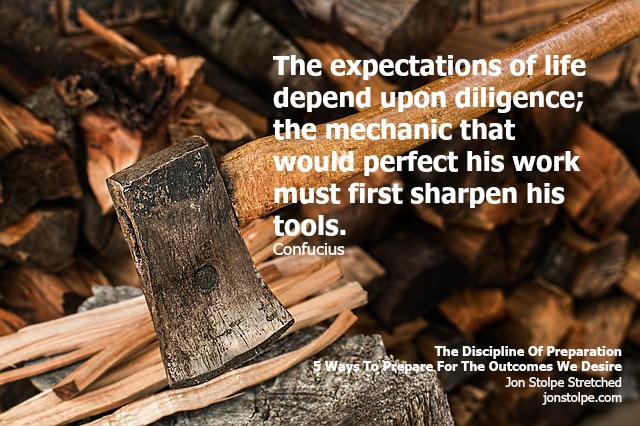
The expectations of life depend upon diligence; the mechanic that would perfect his work must first sharpen his tools.
Confucius
As long as I can remember, I have always taken great pride in keeping a nice lawn. I may have been influenced by my Grandpa Miller who always kept his lawn green and well manicured when I was younger. My obsession with a nice lawn may also have been shaped by my experience as a teenager cutting people’s lawns throughout the area.
When we moved into our brand new house over nine years ago, I was committed to making sure m lawn was well maintained. Once our grass started coming in, I fertilized it. I aerated it. I watered it. And I did my best to make sure it was cut just right with straight lines or near perfect geometric shapes.
One summer, I decided to let it go, and I was left with a burned out, weed infested mess. My grass was gone, and there were ugly weeds everywhere.
This year, we have experienced an unusual spring drought. My grass started turning brown before Memorial Day this year, and I knew it could only get worse without significant rain.
Over the past week, the rain arrived and lasted for a few days giving my lawn the drink it needed. And my grass started growing again. Tuesday night, I decided to cut the grass after work and dinner. I opened the shed and backed my John Deere lawn tractor out of the shed. I turned the blades on, and I began to move forward across my lawn.
It didn’t take long to see there was something wrong. The blades on my mower were turning, but they were struggling to leave a nice clean cut. In fact, there were many parts of the lawn that looked like a bad haircut. I had to overlap my driving pattern and cut the lawn multiple times to get it looking even. I didn’t have time to stop and sharpen the blades the other night as the rest of my week was very busy, but I ended up spending a lot more time cutting the grass because of the dull blades.
This weekend, I’ll be climbing under my tractor to remove the blades so I can sharpen them for the next mowing.
The whole experience reminded me of the importance of proper preparation. The discipline of preparation can be a real challenge for many of us. We lack the patience to wait long enough to make sure we are ready to tackle a project or task. And then, we’re left disappointed my an outcome that doesn’t measure up to our expectations.
If we want to avoid this disappointment, it’s time we practice the discipline of preparation. Here are # ways to prepare so we can experience the outcome of our desires:
5 Ways To Prepare For The Outcomes We Desire
- Read the instructions. I’m a pretty handy guy. As a mechanical engineer, I sometimes think I can get away with doing something without reading the directions. I’ve learned though that the directions help you prepare. When you bake a cake, you don’t through random ingredients into a pan and hope it turns into a cake. You read the instructions to make sure you have the proper tools and ingredients to be successful.
- Request help. I like to do things all by myself. The reality is there are many people who have done things in life already that I’m pursuing now. Asking for help is important to the preparation process. My wife’s dad was the first one to show me how to remove my tractor mower blades. He knew how to do it, because he had done it before on his own tractor.
- Rehearse the project in your head or on paper before you start. Before you set out on a journey, you want to make sure you have the right equipment. You go over your gear again and again to make sure you don’t miss a key item. My son is getting ready to go to Philmont Scout Reservation for two weeks of hiking and camping in New Mexico. He has been practicing and preparing for this trip for months. While this trip will be a challenge, I’m confident he will be successful, because he has put in adequate preparation.
- Reserve the time required to prepare appropriately. When I decided to cut my grass on Tuesday night, I should have given myself more time to check the sharpness of the blades. Because I was in a hurry, I cut my grass with dull blades. Build time in your schedule for preparation.
- Remember your past failures caused by poor preparation. Sometimes the best preparation tool is the memory of our past failures. Don’t let your past go to waste. Learn, grow, and move forward having made the necessary corrections.
I like this quote by Abraham Lincoln who gives valuable insight into the discipline of preparation:
Give me six hours to chop down a tree and I will spend the first four sharpening the axe.
One word of caution: Don’t fall into the trap of over-analysis. Over-analysis leads to paralysis which leads to lack of action and ineffective action. Once you’ve taken the necessary steps to prepare move forward with confidence knowing you’ve put yourself in a position to succeed.