
Book Review: Wooden (Coach John Wooden)
 A friend of mine passed along this book to me before I left for Guatemala last week. I read through most of the book on the way to Guatemala, and I finished it up on the way home. It’s an easy read, and it’s broken up into bite size thoughts and stories.
Wooden: A Lifetime of Observations and Reflections On and Off the Court by Coach John Wooden is a collection of stories and thoughts from the famous UCLA basketball coach. Each story and thought point to a common sense approach to succeeding in life and leadership. In the book, John Wooden shares how he was influenced by his parents, his teachers, his players, and his family to develop his definition of success and his overall view on life.
This is a book that I will reference again and again. It will make a great addition to my office leadership library, and it’s a book I would recommend to anyone who wants to be successful in leadership and life.

My book is full of highlights and notes. Wooden is a wise man who has clearly learned from life. Here are just a few of my favorite quotes from the book:
Being a role model is the most powerful form of educating. Youngsters need good models more than they need critics.
By applying yourself to the task of becoming a little better each and every day over a period of time, you will become a lot better.
You can give without loving, but you cannot love without giving.
Be more concerned with your character than your reputation.
Perfection is what you are striving for, but perfection is an impossibility. However, striving for perfection is not an impossibility. Do the best you can under the conditions that exist. That is what counts.
Success is peace of mind that is the direct result of self-satisfaction in knowing you did your best to become the best that you are capable of becoming.
As a sports fan, I appreciated the sports related stories that appear throughout the book. As a student of life and leadership, Wooden: A Lifetime of Observations and Reflections On and Off the Court offers so much great advice and information to chew on and digest.
What is one thing that you have observed about life that deserves sharing? Share it here!
Sign up for the weekly Stretched newsletter. Check out this post to find out how to sign up.
Book Review: The Catalyst Leader by @bradlomenick

If you are looking for a leadership book that will challenge you and inspire you, look no further. The latest from Brad Lomenick is just what you need.
 In The Catalyst Leader, Lomenick shares 8 Essentials For Becoming A Change Maker.
The book is packed with great quotes, stories of inspiration, and practical advice for leaders who want to STRETCH and grow – who want the make a difference. Besides the quotes, stories, and advice, I love the links found in the book that provide access to all kinds of other information and inspiration.
Lomenick shares stories from his past and from his most recent experience at the leader of Catalyst – perhaps the biggest and most influential leadership conference and organization in the world today. He explains the 8 characteristics of a catalyst leader:
- Called
- Authentic
- Passionate
- Capable
- Courageous
- Principled
- Hopeful
- Collaborative
I have marks and notes all over this book. I am pleased to add this to my leadership library, and it’s a book I’ll come back to again and again for practical tips in how I can become a better leader in my work, at my church, and in my home.
If you are a leader, consider picking up a copy of The Catalyst Leader today. I don’t think you’ll be disappointed. This is definitely a resource that I recommend.
How have these Catalyst characteristics changed your leadership? What is one thing you can do this week to become a change maker right where you are? What leadership books do you recommend adding to my library?
Workplace Wisdom – Representing Christ In Our Response To Others
 For those of you who may not know, I am an operations manager for a company that designs and installs building automation systems into new and renovated facilities throughout the Philadelphia area. I’ve been working for the same company for 17 1/2 years, and I’ve been in the industry for 19 years. Honestly, I like what I do … most days. I have the opportunity to help people succeed in reaching their career goals, and I have the opportunity to help customers as they seek to find energy-saving and money-saving solutions for their buildings.
People have asked me repeatedly about my career choice. They ask why I didn’t go into full-time missions. They ask me if I’ve ever considered becoming a pastor.
Being a Christian leader in the workplace has its challenges.
Being a Christian in the construction industry can really be tough.
But I’m convinced that God has called me to full-time missions right where I am. I work in an industry where many people are far from God. Coarse language and vulgar conversation is unfortunately not uncommon. There are a ton of people in this industry who need to find Christ and need examples to follow.
Most people at my office know that I’m a Christian, and they know that I’m a pastor’s son. I haven’t tried to hide this fact. But sometimes this puts me in a spotlight where I’m not always comfortable.
The other day, a coworker laid into me for a good ten to fifteen minutes about something that wasn’t my fault. The verbal lashing was completely uncalled for, and I honestly felt like lashing back at this employee. My natural response was to be defensive and to scream back at him. After taking the verbal abuse, I quietly left the room and proceeded to my next meeting. I was frustrated. I was worn out. And I was somewhat perplexed on how to move forward with this employee.
Several years ago, a couple of people in my office started calling me the Raging Reverend. For me, this wasn’t the most flattering nickname. I don’t want to be known as someone who acts with rage in the workplace. I want to be someone who sets the tone for a more positive working environment. I want to show people it’s okay to follow Christ and to work in this tough industry. I want to point people to a better way.
After my meeting and attending to a few other tasks, I knew it was time to approach this employee. While this employee doesn’t directly report to me, I have a responsibility to lead him and to work with him so he can best support other employees in the office. I returned to him with an update on a different topic. The conversation on this topic was brief, but it gave me a chance to break the ice. From there, we got back to the issue which caused the verbal outbreak. As we got back into the issue, he quietly apologized to me confessing to me his need to learn to control his mouth – to think before he speaks. We dealt with the issue and moved on. I was able to empathize with his own frustrations which led to his outburst, but I was able to let him know that it wasn’t acceptable to respond the way he did – to me, to other managers, to fellow employees, or to customers.
I don’t always get it right. I say things I shouldn’t, and I don’t get it right 100% of the time. But people are watching. They want to see how I respond to my own mistakes and to the mistakes of others. How we respond to our own missteps and to the missteps of others matters. We must learn to respond with grace, gentleness, patience, and truth.
Be wise in the way you act toward outsiders; make the most of every opportunity. Let your conversation be always full of grace, seasoned with salt, so that you may know how to answer everyone. Colossians 4:5-6
How can you better represent Christ in your workplace today? What suggestions do you have for responding to situations like the one I encountered this week?
I look forward to reading your response in the comments!
One-On-One Meetings – A Powerful Leadership Tool

Today, I’m visiting Matt McWilliams for a post about the power of one-on-one meetings. Here’s an excerpt from my post:
Several months ago, Matt encouraged his readers to establish and maintain weekly one-on-one meetings with their direct reports. At the time, I was contemplating what I could do to connect with my team on a deeper level.
As an operations manager in the construction industry, I’m challenged to balance my time as I’m responsible to make sure my group is operating as planned. I meet with my team members monthly on an individual basis to review their projects to review their projects from a financial, resource, risk, and customer perspective. These monthly meetings, which typically last about an hour, provide a pretty good snapshot of things from a business perspective, but they don’t provide a lot of time for diving deeper personally.
I’m also responsible for participating in other department and company meetings. Again, these meetings are important for certain aspects of our business success, but they typically don’t provide opportunity for connecting on a more personal level.
I’ve heard it said that “It’s business, it’s NOT personal.” Well, I disagree. As a Christian leader in the workforce, I have a responsibility (and privilege) to represent Christ well. For me, this means our relationships in the business world are meant to be personal.
How can we take time to connect with our team members with all the different demands on our time?
You can click here to read the rest of the post. While you’re there, check out Matt’s blog. He writes a lot of practical posts about life and leadership.
If you’re visiting from Matt’s blog, I’m glad you stopped by. I hope you’ll check things out and become a regular part of The Stretched Community. You can sign up to receive daily blog updates by adding your e-mail on the main page (I promise not to send you spam). To help you get a taste of my other writing, here are a few of my favorite posts:
What Does Worship Look Like?
Come, let us bow down in worship,
let us kneel before the Lord our Maker;
for he is our God
and we are the people of his pasture,
the flock under his care.Psalm 95:6-7

When you hear the word worship, what comes to mind?
I think of going to church and singing. I think this is the answer that is drilled into our heads from an early age – not necessarily on purpose but by tradition. I don’t think that answer is wrong, but I think it short sells worship – big time!
What does it look like for a leader to worship?
A leader is responsible for leading the way towards transformation. Paul talks about transformation in the book of Romans, and he provides a glimpse of what it looks like for a leader to worship.
Therefore, I urge you, brothers and sisters, in view of God’s mercy, to offer your bodies as a living sacrifice, holy and pleasing to God—this is your true and proper worship. Do not conform to the pattern of this world, but be transformed by the renewing of your mind. Then you will be able to test and approve what God’s will is —his good, pleasing and perfect will. Romans 12:1-2
Typically when I read these verses, I read about sacrifice and about transformation. And I skip right over “this is your true and proper worship”. If I’m reading this from a leaders perspective, I worship God when I give of myself sacrificially to serve and to lead others. This didn’t say anything about going to church and singing.
So what is worship?
Of course, worship happens at church, but I think there’s so much more.
Worship is the way I live my life. I worship God when I put Him first in everything I do. I can worship God in my parenting, in my marriage, in my friendships, in my exercise, in my job, and even in my writing.
Our worship can be misdirected. We easily get caught up in this culture of consumerism and celebrity. We put movie stars and sports stars on pedestals. We watch TV shows like American Idol (I like that show), Dancing With The Stars, and Celebrity Apprentice. We are consumed with thoughts of greed – “I have to have this” or “I have to have that.” This is all misdirected worship.
God says, “I am the Lord your God, who brought you out of the land of Egypt, out of the house of bondage. You shall have no other gods before Me. You shall not make for yourself a carved image—any likeness of anything that is in heaven above, or that is in the earth beneath, or that is in the water under the earth; you shall not bow down to them nor serve them. For I, the Lord your God, am a jealous God, visiting the iniquity of the fathers upon the children to the third and fourth generations of those who hate Me, but showing mercy to thousands, to those who love Me and keep My commandments.” Exodus 20:2-6
We have a choice to make. We can allow the distractions of this world to hijack our attention – our worship. Or we can choose today to worship God – at home, at church, at work, and throughout our lives. What’s your choice?
What does worship look like for you today? How do you worship God?
The Stretched Blog Visits Joseph Lalonde – Leading From Our Hands And Our Knees

Today, I’m guest posting as part of The Network for Joe Lalonde at his blog, Joseph Lalonde. In my post (Leading From Our Hands And Our Knees), I share some thoughts about servant-based leadership. Here’s an excerpt to get you started.
How are your hands and knees?
For so many, leadership is all about a position of authority. When most people think of leadership, they think of someone sitting in the plush corner office. They think of someone sitting on a throne. Or they think of someone who stands tall above everyone else.
Authority is an important aspect of leadership, but there is something else leaders should consider.
Leaders lead best when they lead from their hands and knees.
(Click here to read the rest of this post.)
If you’re visiting from Joe’s blog, I’m glad you stopped by. I hope you’ll check things out and become a regular part of The Stretched Community. You can sign up to receive daily blog updates by adding your e-mail on the main page (I promise not to send you spam). To help you get a taste of my other writing, here are a few of my favorite posts:
- Leap of Faith
- Less Like Scars
- Ten Things Every Small Group Leader Should Know
- The Power of the Next Question
- How To Respond To The Election Results
How could servant-based leadership impact your leadership effectiveness? What is one thing you can do this week to lead from your hands and knees?
Love Works Wednesday Link Up Conclusion
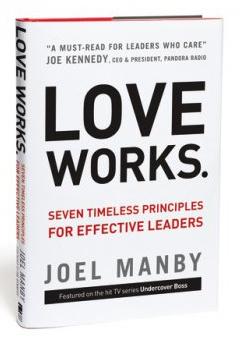
Today marks the conclusion of the Wednesday series based on Love Works by Joel Manby. Some of you maybe happy; some sad; and some just plain indifferent. In today’s post, Bill Grandi (The Cycleguy) and I wrap up this 10 week discussion. I hope you’ve learned something along the way and been challenged as well. Check out Bill’s take by clicking here.
To help you recap, here are the posts from the series:
- Love Works Wednesday Link Up Week 1
- Love Works Wednesday Link Up Week 2 – Patient
- Love Works Wednesday Link Up Week 3 – Kind
- Love Works Wednesday Link Up Week 4 – Trusting
- Love Works Wednesday Link Up Week 5 – Unselfish
- Truth: Love Works Wednesday Link Up Week 6 – Truthful
- Love Works Wednesday Linkup Week 7 – Forgiving
- Love Works Wednesday Linkup Week 8 – Dedicated
- Love Works Wednesday Linkup Week 9
What did I learn from this series? Ten weeks go by pretty quickly. It has been a real pleasure to link up with Bill on a regular basis like this, and it’s been very interesting to get your input into the discussion each week through the conversation in the comments. Bill’s posts tended to focus on leadership from a ministry perspective, and my posts leaned more towards corporate leadership. I think it has been reaffirming to see that love based leadership can apply to various locations of leadership – the church, the office, the home, and elsewhere. Though I had read the book before, I was reminded that you and I can make a difference when we choose to lead with love.
Now it’s your turn. What is one thing you learned through this series? What principle stretched you the most? How has your leadership been transformed by Love Works?
Love Works Wednesday Linkup Week 9
We continue the Wednesday series based on Love Works by Joel Manby. In today’s post, Bill Grandi (The Cycleguy) and I are discussing the tenth chapter (A Choice You Make). Check out Bill’s take by clicking here.
Since I already read the book, I thought it would be interesting to highlight some of the sentences I underlined when I read the book initially:
- “’Profitability is a necessary condition for existence and a means to more important ends, but it is not the end in itself for visionary companies. Profit is like oxygen, food, water, and blood for the body; they are not the point of life, but without them, there is no life.'” Jim Collins – Author of Built to Last (p. 171)
- “Enduring and successful companies are more ideologically driven and less purely profit focused than companies that don’t perform as well financially.” (p. 171)
- “‘There are two essential activities that take time: developing an organization and developing a brand. Those activities are parallel and interdependent. Leadership is about teaching an organization what you stand for; brand building is about teaching millions of consumers what you stand for. Leadership and brand building require time, consistency, and constancy.'” Joe Kennedy – CEO of Pandora (p. 173)
- “Shaping corporate culture is up to individuals across the hierarchy, no matter what their job title is. Any of us can make a real difference.” (p. 175)
- “Never lose an opportunity to bring sunshine into the life of another. A few encouraging words could make a huge difference in someone’s life. (p. 176)
- “Leading with love is too important to be left to chance. It takes effort to lead with the principles of love – to be patient, kind, trustful, unselfish, truthful, forgiving, and dedicated.” (p. 182)
We live in a time of entitlement – at least here in America. People think that things should be handed to them and that the hard work of making things better belongs to others. Many people are looking to their organizations, to other organizations, and to the government to take the leading role in changing the world.
While organizations and political entities may play a role in this change, I’m convinced that true change will only happen when individuals stand up and decide to take action. Love based leadership is up to you and me. We can’t wait for others to jump on board and take charge. We have to be the trailblazers in our companies, in our churches, in our communities, and even in our homes.
We all have a choice to make. We can sit around waiting for the world to change. Or we can be the change that the world needs. It starts with us leading with love. As Manby states in this chapter, it doesn’t matter whether you’re the CEO, a mid-level manager, a front-line employee, or the janitor. How you live and act will impact your span of influence. From there it will spread like ripples in a still pond until the whole body of water is impacted.
Choose today to lead with love. Choose to make a difference. Choose to set the tone where ever you are today.
Next week, Bill and I will conclude our exploration of Love Works and love based leadership. It’s been a great adventure. Be sure to check out next week Wednesday’s post for the conclusion of the series. (And don’t forget to stop back every day between now and then for more great Stretched content.)
How will YOU make a difference TODAY? What will you do to lead with LOVE today? What difference have you seen around you when one person decides to take action?
Love Works Wednesday Linkup Week 8 – Dedicated
We continue the Wednesday series based on Love Works by Joel Manby. In today’s post, Bill Grandi (The Cycleguy) and I are discussing the ninth chapter (Dedicated: Stick To Your Values In All Circumstances). Check out Bill’s take by clicking here.
As a reminder, Manby’s premise is that leadership is best when it comes from a position of agape love based on I Corinthians 13 (“…[love] always protects, always trusts, always hopes, always perseveres.”). Since I already read the book, I thought it would be interesting to highlight some of the sentences I underlined when I read the book initially:
- “One of the primary roles of a leader is to give hope.” (p. 150)
- “A leader needs to clearly communicate how the organization will win in a competitive marketplace and then execute that plan.” (p. 150)
- “We need to care HOW people achieve their tasks, not only IF they achieve them.” (p. 150)
- “‘Power without love is reckless and abusive, and love without power is sentimental and anemic.'” Dr. Martin Luther King Jr. (p. 153)
- “Love and power must be harnessed together to get the most important things done.” (p. 153)
- “The USE of power need not become the ABUSE of power.” (p. 154)
- “Leading with love is more important than the temporary approval of your coworkers.” (p. 155)
- “Many organizations talk about values, but few truly integrate those values into how leaders are evaluated and chosen and how organizational results are measured.” (p. 156)
- “It’s critical to define the values that will drive our lives…. What kind of person do we want to be? What values will we uphold? What kind of integrity will we have when nobody is watching? How do we want to treat others regardless of how they treat us?” (p. 156-157)
- “It’s one thing to TALK about values like leading with love, but it’s another thing to DELIVER on those values, especially in tough times.” (p. 164)
When we think of dedication, we typically think of someone who is committed to someone or to an organization. We think of someone who comes in early and stays late. We think of team members who consistently go the extra mile. Most managers I’ve encountered in the corporate world would be considered dedicated by this definition.
Joe Manby takes it to another level with his discussion in chapter 9. According to Manby, a dedicated leader is someone who leads out of solid values. There are several leaders I’ve encountered in the corporate world that lead out of a value-focused position, and there are many leaders who don’t seem to be concerned with values as much as climbing over whoever to get to the top and crushing the competition.
I thoroughly appreciate Manby’s take on power and love. Leaders can get a bad reputation when they misuse their power. I’m convinced that a love-based, value-focused use of power will not only improve leader reputation, it will lead to the overall enhancement and advancement of the organization, the employees, the customers, the stockholders, and the community at large.
When you and I hear the word “dedicated”, we must get past the hard-working, tunnel-visioned definition. Starting today, let’s define “dedicated” to mean so much more.
Over the next two weeks, Bill and I will conclude our exploration of love based leadership. I hope you’ll read along, jump into the comments, and maybe even change the way you lead. Consider getting a copy of Love Works for yourself, and see how this book might change you and your leadership.
What is one thing you can do differently this week to become a more dedicated leader? How have you been led with dedicated, love-based leadership?
Love Works Wednesday Linkup Week 7 – Forgiving
We continue the Wednesday series based on Love Works by Joel Manby. In today’s post, Bill Grandi (The Cycleguy) and I are discussing the eighth chapter (Forgiving: Release The Grip Of The Grudge). Check out Bill’s take by clicking here.
As a reminder, Manby’s premise is that leadership is best when it comes from a position of agape love based on I Corinthians 13 (“…[love] keeps no record of wrongs”). Since I already read the book, I thought it would be interesting to highlight some of the sentences I underlined when I read the book initially:
- “I am not suggesting that we toss out our organizational standards and goals – simply that we keep our hearts soft enough to be open to forgiveness.” (p. 140)
- “Forgiveness releases you, not the person you are forgiving.” (p. 146)
- “An act of forgiveness is a pebble in the pond, and the ripples can continue far beyond our ability to know.” (p. 146)
Forgiveness is an interesting topic when it comes to the marketplace. So much of the corporate world is cut-throat and leaves little time for forgiveness and restoration. If something or someone isn’t working out, they are quickly discarded. And if someone wrongs the company, they are removed and their reputation is run through the mud.
As a manager in the corporate world, I see both sides of the forgiveness fence. I have a responsibility to be a good steward of the company’s resources, and I am tasked with making decisions for the betterment of the company. I am sometimes faced with employee issues that require tough decisions, disciplinary action, and removal from the company. I also have a responsibility to my team. I need to support them, to help them succeed, and to push them to improve performance.
I’m proud to work at my company and in my department. Within the department management team, I have seen a desire for restoration whenever possible. In the restoration process, forgiveness happens to the extent that an employee is encouraged to progress past previous lapses. When an employee is open to personal changes, it is often possible to retain an employee, to forgive them, and to restore them to good standing.
Obviously, there are times when this isn’t possible. If an employee is intentionally harming the company or threatening the well-being of fellow employees, it may be necessary to release an employee from the company. Even when this happens, we can learn to forgive.
Failure to forgive can leave us crippled by the past. How we respond with forgiveness impacts our own leadership in the office, at church, or in the home. As leaders, we are an example. I want to model forgiveness for those I lead.
Over the next two weeks, Bill and I will continue to explore love based leadership. I hope you’ll read along, jump into the comments, and maybe even change the way you lead. Until then, consider getting a copy of Love Works for yourself, and see how this book might change you and your leadership.
What is one thing you can do differently this week to become a more forgiving leader? How have you been led with forgiving, love-based leadership?