
One Way To Become A Better Coach For Your Team

A month ago, I attended the Foundation Leadership Program with 22 other colleagues from North and South America. (To read more about my experience, click here.) It was the best week I’ve had in my 20+ years with the company. One of my biggest takeaways from the experience relates to how I coach others.
Coaching others isn’t about giving the answers.
Coaching is about helping others discover the answers for themselves.
I’m a fixer, so I naturally want to dive in and figure out the exact steps necessary to overcome a challenge. Here’s the problem: Our team members don’t need a fixer. They don’t need someone else to do the work for them. They don’t need someone to do the thinking for them. When we as leaders jump in to fix things, we take away valuable opportunities for our team members to think for themselves and to take action.
As leaders, we need to give our team members the opportunity to learn, to think, to take action, to succeed, and to fail.
To effectively coach our team members, we should use the GROW Model for handling the discussions with our team members.
Here’s what Wikipedia has to say about the GROW Model:
The GROW model (or process) is a simple method for goal setting and problem solving. It was developed in the United Kingdom and was used extensively in corporate coaching in the late 1980s and 1990s.
There have been many claims to authorship of GROW as a way of achieving goals and solving problems. While no one person can be clearly identified as the originator, Graham Alexander, Alan Fine, and Sir John Whitmore all made significant contributions. Max Landsberg also describes GROW in his book The Tao of Coaching. Other similar models include collaborative helping maps in family therapy and Gabriele Oettingen‘s WOOP model.
This is what I learned in my leadership program:
- G stands for Goal. When coaching your team members start with the goal. The goal may change as the discussion moves along, but it is the starting point for your coaching discussion.
- R stands for Roadblocks. It’s helpful to identify the things that are standing in the way of achieving your goal.
- O stands for Options. What options does one have to overcome the roadblocks that stand in the way of achieving the goal? When discussing the options, it may become obvious that the goal needs to be re-calibrated. When the goal shifts, we have to go back and look at the roadblocks standing in the way of achieving the new goal.
- W stands for Will. Is your team members willing to take action on the identified options? If the answer is no, it’s time to go back to the drawing board (or end the discussion). If the answer is yes, the discussion transitions into action.
Who are you leading? Maybe you are leading in your business or place of employment. Maybe you are leading in your community. Or maybe you are leading in your home.
Whatever the case may be, it’s time for you to help your team members GROW (or STRETCH as I like to say). Learn to become a better coach, and discover a path to greater success among those you lead.
What methods have you used to help your team members tackle their problems? What step(s) do you need to take TODAY to help your team members? Share your thoughts in the comments.
If you’re looking for more ways to STRETCH yourself, sign up TODAY for the 7 Week Stretch Challenge:
Know Yourself – How To Get Started In Discovering The Real You

Know yourself. Don’t accept your dog’s admiration as conclusive evidence that you are wonderful.
Ann Landers
How well do you know yourself?
You have lived with yourself your entire life. You should have a pretty good idea of who you are and what makes you tick.
In reality, many of us don’t really know all that much about ourselves. We look in the mirror to make sure our hair is styled nicely and our face is clear of any major blemishes, but we too often fail to look deeper.
Getting to know ourselves takes time, energy, and perhaps some expert advice.
Two weeks ago, while I was in Chicago for a leadership development program, we spent the better part of a day getting to know ourselves better. Before we can lead others well, we must learn to lead ourselves. And self leadership starts with self discovery. As part of this process, each of the participants in the program had to take the MBTI (Myers-Briggs Temperament Index). I’ve taken this assessment before, so it was not a surprise to me that my results showed I am an ESTJ. I’m more of an Extrovert than an Introvert. I rely on Sensing as opposed to iNtuition. I’m much more of a Thinker than a Feeler. And I’m more likely to Judge than to Perceive.
Here’s what the report had to say about me:
ESTJ Snapshot
ESTJs are logical, analytical, decisive and tough-minded individuals who use
concrete facts in systematic ways. They enjoy working with others to organise
the details and operations well in advance to get the job done. Although the
descriptors below generally describe ESTJs, some may not fit you exactly due to
individual differences within each type.
Decisive
Direct
Efficient
Gregarious
Logical
Objective
Organised
Practical
Responsible
Structured
Systematic
Task-focused
My MBTI results report had a lot more to say about who I am, how I tend to behave, and how I may need to adapt to potential pitfalls in my behavioral preferences. I learned a lot as a result of going through this assessment.
A couple of months ago, I did the Strengthsfinder 2.0 self assessment which helped me see my top five strengths: Harmony, Achiever, Responsibility, Disciplined, and Analyzer. My friend, Rusty Pang, recently helped me see how these strengths help to describe who I am:
“When I interpret your strengthfinders results in your personality, I see a consistent, reliable person who is a studied peacekeeper. You don’t like it when two or more people are in conflict, so you rely on your training and knowledge to fix the problem directly or create a system to promote cooperation.“
Rusty’s feedback was right on. I am completely stressed out by conflict. I want people to get along, and I want to find ways to bring resolution to situations where people don’t get along or don’t see eye to eye. When I can’t make this happen, I become restless, I lose my appetite, and I struggle to sleep well.
Learning more about yourself is more than taking a self assessment test, but this kind of tool can start you down the right path. Here’s a list of a few self assessments, you may want to try to learn more about yourself:
- MBTI (Myers-Briggs Temperament Index) – To take the assessment for FREE, click here.
- DISC Profile – To take the DISC personality test for FREE, click here.
- Strengthsfinder 2.0 – To take this assessment, you have to purchase the book to get the code required to access the test. Click here to get the book.
Once you have the results from these types of assessments, it’s extremely valuable to sit down with a coach or expert who can help you interpret the results to get the most of your self learning. Here are a few people I recommend you check out if you are looking for assistance in interpreting your results. They can help you learn more about yourself:
- Rusty Pang In his own words: “I’m a big believer in people and systems. Over the years, I have developed a system to identify, understand and empower individuals to be their best selves. Entrepurpose is how I’ve scaled the belief that everyone can know and live their purposes.”
- Chris LoCurto From Chris’ LinkedIn profile: “For over a decade my goal has been helping people and businesses to become the strongest and most effective they possibly can. I work with entrepreneurs, leaders, and individuals focusing on business, leadership, teams, personality styles, and life.”
- Lily Kreitinger From Lily’s site: “As a Certified LifePlan Facilitator I help individuals grow and thrive by following a tried and true discovery process to the life they were meant to live.”
Once you learn more about you, you’ll be in a better position to lead yourself and others. What’s stopping you?
Have you taken any of these assessments? What were the results? What other suggestions do you have for getting to know yourself better? Share your thoughts in the comments below.
A Full Head, Heart, and Belly – Reflections on My Week of Leadership Development

My head is full. My heart is very full. And my belly is pretty full too. This is how I feel after an intense week of leadership development.
Last week, I spent my time at the Eaglewood Resort & Spa in Itasca, IL (just outside of Chicago) with 22 other Siemens leaders from around the world. It was such an honor to be included with such wonderful company. My peers came from Peru, Brazil, Costa Rica, Mexico, Canada, and the United States, and we gathered for an exclusive leadership development course.
It will take a while for me to fully digest my experience, but I wanted to share some of my initial thoughts:
- Teamwork can take you far. As part of the experience, I was put on a team with five other participants. We had the opportunity to work together on several assignments throughout the week, and I’m happy to say we were successful because we learned how to work together making the most of the different talents and skills we each brought with us.
- Being present is essential to get the most of our experiences and conversations. We spent a lot of time learning to listen, learning to be assertive, and learning to coach. These things are not effective if we are not fully engaged with others.
- Not everyone has my behavioral preferences and personality tendencies. I must learn to be aware of how others recharge and respond to situations. I must also learn to adapt my behaviors to lead more effectively.
- Getting feedback from others is crucial to helping me grow. Before I left, I had several people from my office give me feedback through a 360 degree feedback survey. I also received feedback from my teammates throughout the week. Receiving feedback from others isn’t always easy. It requires humility, open ears, and a willingness to analyze, adapt, and accept. The feedback I received was encouraging and eye-opening. It provided an opportunity to look in the mirror and discover more about me.
- Transparency opens the door to team growth. Within a few hours, my team shared aspects of our past that influenced our leadership and life up until this week. The stories shared led to more stories. The stories bonded us together in a way I hadn’t expected. By the end of the week, I not only had a team of colleagues – I had a team of friends and personal cheerleaders. I now have people in Brazil, Mexico, Canada, and the United States who I grew close to me. I know I’ll be able to connect with them when I have a leadership issue I need to navigate.
- My leadership will only get better when I let others lead. I have a natural tendency to take on more than I should. I fail to delegate and to pass off leadership to my team, because I want to make sure things are accomplished at my standard. If I don’t let others lead, I’m doing a disservice to them, to me, and to my company. As I head back to work today, I’ll be looking for ways to let others lead.
- I’m excited for the future of my company. In my 20+ years with the company, I have never experienced this type of training. I had the chance to rub shoulders with the up and coming leaders in the company, and they have so many great ideas which will propel our company forward into the future.
These thoughts only brush the surface of my experience last week. I left the week exhausted. I’ve spent a lot of time in silence since I left the resort on Friday afternoon. My head is full with ideas and questions related to how I will implement my learnings.
My heart is full, because I had the opportunity to dive fairly deep into the lives of several new friends. The coaches along with my colleagues left me feeling valued and accepted.
My belly is full, because they kept feeding us. Thankfully, I hit the fitness center four of the five mornings I was at the resort. This week I will get back into a more healthy and normal routine.
If you want to STRETCH your leadership, you need to invest your time and energy (and maybe some money) into yourself. This week was all about making that investment, and I’m so excited to move ahead with the new tools in my tool belt.
When was the last time you invested in yourself? How did you STRETCH as a result of this experience? Share your thoughts in the comments below.
Taking Time To Invest In The Next Generation
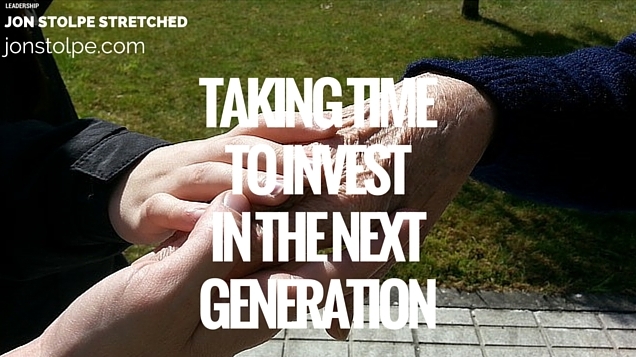
Leadership is not about the next election, it’s about the next generation.
Simon Sinek
I volunteer on Sunday night as an adult leader at my church’s high school youth group, and I have a confession: I don’t always enjoy it. I sometimes feel out-of-place. I sometimes feel like I’m the “old guy.” And I occasionally wonder if I’m making a difference.
(How did I become the “old guy”?)
This weekend, I was talking to my wife about some recent thoughts and observations regarding my role.
Without fail, I end up having a few conversations each week with students. These conversations confirm my initial decision to volunteer with this ministry.
Students arrive at youth group with all kinds of baggage.
- They are stressed out, because they have a big project, paper, or test due in the coming days.
- They are exhausted, because they are super involved in sports, music, or other activities.
- They are lonely, because they don’t have real friends.
- They are insecure, because they don’t have a secure and stable home life.
- They are confused, because they are flooded with conflicting messages at home, at school, and especially on-line.
- They are struggling, because they don’t fit in, they got involved with an unhealthy habit or relationship, and they are afraid to ask for help.
I can’t solve their problems, but I can be there to listen. I can give them feedback based on my experiences. I can be there to be a positive example in their lives. And I can be there to let them know they are valued.
In my discussion with my wife, I was reminded of the importance of plugging into those who are younger. If you are reading this, you more than likely have experiences and wisdom to share with others. You have the opportunity to become a mentor, an advocate, and a cheerleader for those coming behind you.
If you want to leave a legacy…if you want to be stretched, be intentional. Invest in those who are younger than you.
When you do this, you’ll discover:
- There is hope for the future.
- The next generation is full of promise.
- The youth of today can actually teach you.
- You can make a difference in the lives of those who are younger than you.
If you feel like you still have a long way to go (and we all have a long way to go), seek out a mentor for you.
I have a renewed respect for those who invested in me. I think of my youth leaders. I think of my teachers, I think of my bosses. I think of my parents. I’m guessing they had similar concerns about my generation, and yet they continued to invest in people like me. They listened to me. They encouraged me. They pushed me forward. They loved me, and they helped me feel valuable.
Now it’s my turn!
And it’s your turn too!
Who invested in you? How are you investing in the next generation?
For other related articles, check out:
- Mentoring – Am I Ready For This? (Jon Stolpe Stretched)
- The Discipline of Getting Feedback (Jon Stolpe Stretched)
- Mentor Like Yoda (Joseph Lalonde)
- How to Find a Mentor to Help You Go Further, Faster (Michael Hyatt)
- Why You Need A Mentor (Chris LoCurto)