
The Raven Charter – Thousand Words

I’m very proud of my “little” brother, Erik. His band, The Raven Charter, just posted a new song on their mySpace page. Check out Thousand Words. Erik plays piano and acoustic guitar, and he also sings. I think it’s a great new song. I’m looking forward to more.
Mahna Mahna
I just posted this on facebook this morning. This is what I grew up on – Saturday nights. Maybe this explains it…
[youtube=http://www.youtube.com/watch?v=QTXyXuqfBLA&hl=en&fs=1]
A Man Who Will Be Missed – Millard Fuller
Today, the world lost a servant. I was saddened today to learn that Millard Fuller, the founder of Habitat for Humanity, had passed away after a brief illness. I had the privilege of meeting Mr. Fuller when he came and spoke at one the the Men's Lenten Breakfasts many years ago at First Presbyterian Church in Mt. Holly, NJ. He left a big impression on me and an even bigger impression and lasting impact on the world.
Here's what CNN had to say about this amazing person:
ATLANTA, Georgia (CNN) — Millard Fuller, who founded Habitat for Humanity International along with his wife, has died, officials said Tuesday. He was 74.
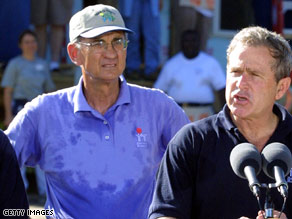
Millard Fuller appears with President Bush at a Habitat for Humanity event in Tampa, Florida, in 2001.

Fuller died early Tuesday "after a brief illness," said a statement on the Web site of the organization he currently headed, Fuller Center for Housing, in Americus, Georgia.
"Family and friends are mourning the tragic loss of a great servant leader and a genuine heart," the statement said.
Fuller had suffered from chest congestion for three to four weeks, said Holly Chapman, spokeswoman for the Fuller Center. He died about 3 a.m. en route to a hospital, she said.
With his wife, Linda, Fuller founded Habitat for Humanity International in 1976.
The Alabama native rose "from humble beginnings" to become a "young, self-made millionaire," according to his biography on Habitat for Humanity's Web site. He and a college friend began a marketing firm while still in school, "but as his business prospered, his health, integrity and marriage suffered," the biography said.
"These crises prompted Fuller to re-evaluate his values and direction. His soul-searching led to reconciliation with his wife and to a renewal of his Christian commitment," it said.
The Fullers sold all their possessions, gave money to the poor and began searching for a new direction. They found Koinonia Farm, a Christian community near Americus in rural southwest Georgia, the biography said.
Along with Koinonia founder Clarence Jordan and a few others, the couple initiated several enterprises, among them a housing ministry that built modest homes on a no-interest, nonprofit basis and made them affordable to low-income families.
Homeowner families were expected to use their own labor to help defray costs on their home as well as homes for other families. Money to build homes was placed into a revolving fund, enabling more to be built, according to the biography.
In 1973, the Fullers moved to Africa to test their housing model, the biography said. Their project was launched in Zaire — now the Democratic Republic of the Congo — and was a success. "Fuller became convinced that this model could be expanded and applied all over the world," the biography said.
When Fuller returned to the United States three years later, he met with a group of associates to create Habitat for Humanity International. According to its Web site, Habitat has provided shelter for more than 1.5 million people in more than 3,000 communities.
"I see life as both a gift and a responsibility. My responsibility is to use what God has given me to help his people in need," Fuller once said, according to Habitat's Web site.
Former President Carter, a key Habitat supporter, fellow Georgian and a close friend, issued a statement Tuesday saying Fuller "was one of the most extraordinary people I have ever known."
"He used his remarkable gifts as an entrepreneur for the benefit of millions of needy people around the world by providing them with decent housing," Carter said. "As the founder of Habitat for Humanity and later the Fuller Center, he was an inspiration to me, other members of our family and an untold number of volunteers who worked side-by-side under his leadership."
In 1996, President Clinton awarded Fuller the Presidential Medal of Freedom, the nation's highest civilian honor, calling Habitat "the most successful continuous community service project in the history of the United States."
Fuller left Habitat for Humanity in 2005 amid a dispute with the organization's board. Habitat said in a statement at the time his termination culminated "several months of differences between the Fullers and the board over allegations of inappropriate personal behavior of Millard Fuller toward a now-former female employee," according to an article in the February 2005 edition of Christianity Today magazine.
The organization noted there was insufficient evidence to corroborate the complaint, according to Christianity Today, but said Fuller engaged in "a pattern of ongoing public comments and communications … that have been divisive and disruptive to the organization's work."
For his part, Fuller told the magazine he feared the board used the controversy to push him out to find a "high-paid bean counter" instead of someone with "strong Christian commitment."
"We've overloaded the board with 'money' people, all of whom are nominal Christians, but many of whom are not spiritually grounded," he told the magazine. "Some seem put off by my overt declaration of Jesus."
After his departure, Fuller founded the Fuller Center for Housing, which its Web site describes as "a nonprofit, ecumenical Christian housing ministry dedicated to eliminating poverty housing worldwide."
The center was founded after Fuller "set out to expand his missionary vision" by returning to his roots at Koinonia Farm, a cooperative community dedicated to peace and service.
A new mission statement was issued at Koinonia dedicating the Fuller Center as "a Christ-centered, faith-driven organization witnessing the love of God by providing opportunities for families to have a simple, decent place to live," according to the site.
Funeral services are scheduled for Wednesday, said Chapman, the Fuller Center spokeswoman. Fuller will be buried at Koinonia Farm, according to the center's Web site.
I Have A Dream
 Seems appropriate today to be reminded of the words of Martin Luther King Jr.:
I am happy to join with you today in what will go down in history as the greatest demonstration for freedom in the history of our nation.
Five score years ago, a great American, in whose symbolic shadow we stand today, signed the Emancipation Proclamation. This momentous decree came as a great beacon light of hope to millions of Negro slaves who had been seared in the flames of withering injustice. It came as a joyous daybreak to end the long night of their captivity.
But one hundred years later, the Negro still is not free. One hundred years later, the life of the Negro is still sadly crippled by the manacles of segregation and the chains of discrimination. One hundred years later, the Negro lives on a lonely island of poverty in the midst of a vast ocean of material prosperity. One hundred years later, the Negro is still languishing in the corners of American society and finds himself an exile in his own land. So we have come here today to dramatize a shameful condition.
In a sense we have come to our nation’s capital to cash a check. When the architects of our republic wrote the magnificent words of the Constitution and the Declaration of Independence, they were signing a promissory note to which every American was to fall heir. This note was a promise that all men, yes, black men as well as white men, would be guaranteed the unalienable rights of life, liberty, and the pursuit of happiness.
It is obvious today that America has defaulted on this promissory note insofar as her citizens of color are concerned. Instead of honoring this sacred obligation, America has given the Negro people a bad check, a check which has come back marked “insufficient funds.” But we refuse to believe that the bank of justice is bankrupt. We refuse to believe that there are insufficient funds in the great vaults of opportunity of this nation. So we have come to cash this check — a check that will give us upon demand the riches of freedom and the security of justice. We have also come to this hallowed spot to remind America of the fierce urgency of now. This is no time to engage in the luxury of cooling off or to take the tranquilizing drug of gradualism. Now is the time to make real the promises of democracy. Now is the time to rise from the dark and desolate valley of segregation to the sunlit path of racial justice. Now is the time to lift our nation from the quick sands of racial injustice to the solid rock of brotherhood. Now is the time to make justice a reality for all of God’s children.
It would be fatal for the nation to overlook the urgency of the moment. This sweltering summer of the Negro’s legitimate discontent will not pass until there is an invigorating autumn of freedom and equality. Nineteen sixty-three is not an end, but a beginning. Those who hope that the Negro needed to blow off steam and will now be content will have a rude awakening if the nation returns to business as usual. There will be neither rest nor tranquility in America until the Negro is granted his citizenship rights. The whirlwinds of revolt will continue to shake the foundations of our nation until the bright day of justice emerges.
But there is something that I must say to my people who stand on the warm threshold which leads into the palace of justice. In the process of gaining our rightful place we must not be guilty of wrongful deeds. Let us not seek to satisfy our thirst for freedom by drinking from the cup of bitterness and hatred.
We must forever conduct our struggle on the high plane of dignity and discipline. We must not allow our creative protest to degenerate into physical violence. Again and again we must rise to the majestic heights of meeting physical force with soul force. The marvelous new militancy which has engulfed the Negro community must not lead us to a distrust of all white people, for many of our white brothers, as evidenced by their presence here today, have come to realize that their destiny is tied up with our destiny. They have come to realize that their freedom is inextricably bound to our freedom. We cannot walk alone.
As we walk, we must make the pledge that we shall always march ahead. We cannot turn back. There are those who are asking the devotees of civil rights, “When will you be satisfied?” We can never be satisfied as long as the Negro is the victim of the unspeakable horrors of police brutality. We can never be satisfied, as long as our bodies, heavy with the fatigue of travel, cannot gain lodging in the motels of the highways and the hotels of the cities. We cannot be satisfied as long as the Negro’s basic mobility is from a smaller ghetto to a larger one. We can never be satisfied as long as our children are stripped of their selfhood and robbed of their dignity by signs stating “For Whites Only”. We cannot be satisfied as long as a Negro in Mississippi cannot vote and a Negro in New York believes he has nothing for which to vote. No, no, we are not satisfied, and we will not be satisfied until justice rolls down like waters and righteousness like a mighty stream.
I am not unmindful that some of you have come here out of great trials and tribulations. Some of you have come fresh from narrow jail cells. Some of you have come from areas where your quest for freedom left you battered by the storms of persecution and staggered by the winds of police brutality. You have been the veterans of creative suffering. Continue to work with the faith that unearned suffering is redemptive.
Go back to Mississippi, go back to Alabama, go back to South Carolina, go back to Georgia, go back to Louisiana, go back to the slums and ghettos of our northern cities, knowing that somehow this situation can and will be changed. Let us not wallow in the valley of despair.
I say to you today, my friends, so even though we face the difficulties of today and tomorrow, I still have a dream. It is a dream deeply rooted in the American dream.
I have a dream that one day this nation will rise up and live out the true meaning of its creed: “We hold these truths to be self-evident: that all men are created equal.”
I have a dream that one day on the red hills of Georgia the sons of former slaves and the sons of former slave owners will be able to sit down together at the table of brotherhood.
I have a dream that one day even the state of Mississippi, a state sweltering with the heat of injustice, sweltering with the heat of oppression, will be transformed into an oasis of freedom and justice.
I have a dream that my four little children will one day live in a nation where they will not be judged by the color of their skin but by the content of their character.
I have a dream today.
I have a dream that one day, down in Alabama, with its vicious racists, with its governor having his lips dripping with the words of interposition and nullification; one day right there in Alabama, little black boys and black girls will be able to join hands with little white boys and white girls as sisters and brothers.
I have a dream today.
I have a dream that one day every valley shall be exalted, every hill and mountain shall be made low, the rough places will be made plain, and the crooked places will be made straight, and the glory of the Lord shall be revealed, and all flesh shall see it together.
This is our hope. This is the faith that I go back to the South with. With this faith we will be able to hew out of the mountain of despair a stone of hope. With this faith we will be able to transform the jangling discords of our nation into a beautiful symphony of brotherhood. With this faith we will be able to work together, to pray together, to struggle together, to go to jail together, to stand up for freedom together, knowing that we will be free one day.
This will be the day when all of God’s children will be able to sing with a new meaning, “My country, ’tis of thee, sweet land of liberty, of thee I sing. Land where my fathers died, land of the pilgrim’s pride, from every mountainside, let freedom ring.”
And if America is to be a great nation this must become true. So let freedom ring from the prodigious hilltops of New Hampshire. Let freedom ring from the mighty mountains of New York. Let freedom ring from the heightening Alleghenies of Pennsylvania!
Let freedom ring from the snowcapped Rockies of Colorado!
Let freedom ring from the curvaceous slopes of California!
But not only that; let freedom ring from Stone Mountain of Georgia!
Let freedom ring from Lookout Mountain of Tennessee!
Let freedom ring from every hill and molehill of Mississippi. From every mountainside, let freedom ring.
And when this happens, when we allow freedom to ring, when we let it ring from every village and every hamlet, from every state and every city, we will be able to speed up that day when all of God’s children, black men and white men, Jews and Gentiles, Protestants and Catholics, will be able to join hands and sing in the words of the old Negro spiritual, “Free at last! free at last! thank God Almighty, we are free at last!”
What’s your dream?
What’s The Point?

I read a lot of blogs related to small group ministry. Some of it's really good stuff. One of the blogs I read is called Because Relationships Matter authored by Kathy Guy who is Director of Community at Granger Community Church in Granger, Indiana. I really resonated with a comment made in her post from yesterday:
"Doing more has come slowly and strategically in GCC Groups. We have more choices. People are really happy when they can find what they're looking for.
However, making people happy isn't the goal – it's about helping them connect to the church so they can find their way to Jesus."
In my opinion, this is the point of doing small groups. As I've wrestled through the mission and strategy of the small groups ministry at my own church, my passion is towards seeing people connected to others and to God. If our group ministry doesn't achieve this objective, is it really worth it?
I'd love to hear what you think.
Get Connected in a Group
So much of my heart and soul over the past nine months has gone into planning for the launch of a new approach to small group ministry at our church. Here's a letter below that describes what we're doing. If you live in the CCV area, check it out and consider signing up for a group to start the New Year!
Dear CCV Family,
What better way to start off your New Year than to join a group at CCV?
Joining a small group is a great way to meet people, engage in spiritual discussions and have fun! In 2009, we’re taking a new approach to Small Group ministry by moving to a semester based format. In this new format, there will be a defined beginning and end during which people can easily join or leave a group.
There are a lot of benefits to the semester format. Listed below are just a few:
- There are more opportunities during the year to join a group.
- New groups are added each semester which means more choices.
- There’s no long term commitment, if you don’t want one.
- If a group doesn’t work for you, try another.
Our goal is to help you connect with other people here at CCV and learn more about God. One size doesn’t fit all; that’s why we think it’s important to offer a wide variety of groups. Whether you’re interested in studying the Bible, learning how to study the Bible or you simply want to meet people who are experiencing the same things in life as you are, there’s a place for you.
During Sunday services the last few weeks, there’s been a sign up table in the lobby. For those who haven’t had the opportunity to stop by the table, we thought it would be helpful to send the Group Catalog to you! As you look through the Catalog (attached), you’ll notice there are different types of groups that meet every day of the week around the area. Our “Winter Semester” starts the first week of January and finishes the last week in March. Each group plans to meet 10 – 12 weeks during that time.
There’s still plenty of time to sign up, so click here to go to the CCV website to find a group. Why not sign up? It’s easy, it’s fun and it’s one of the best ways to get connected!
If you have additional questions, please contact me at 610.792.0777 ext. 207 or terri@moviechurch.com.
Happy Holidays!
Terri Stone
Director of Involvement
Top 10 List of Stolpe Christmas Traditions
From the home office in Schwenksville, PA:
Top 10 List of Stolpe Christmas Traditions
10. Putting up lights outside. This is a new tradition for me as of last year. This year I decided that it was much easier and safer to put lights on the shed instead of the house.
9. Swedish food. Korv. Swedish Meatballs. Pickled Herring. Candied Apples. Cheese. Crackers. Rice Pudding. Raspberry Creme. Spritz Cookies.
8. Christmas services. Growing up as a PK, I was always at church for multiple Christmas Eve services. This will continue to be one of our traditions. If you're looking for a service in our area – come to our church for one of the five services being offered.
7. Christmas movies. My all time favorite is – It's a Wonderful Life, but I enjoy many other ones as well.
6. Christmas caroling. This year we'll be caroling at the Colonnade in Schwenksville. It should be a great time. I'm thinking of busting out the saxophone as part of this adventure.
5. Christmas books. This has been a harder tradition to keep this year – with our busy schedules and the kids changing interests.
4. Hanging up Christmas ornaments on December 8th – my birthday. Every year the kids look forward to hearing me explain all the stories about each of the ornaments that I have received since my very first Christmas…1971 – an angel (my only year as an angel), 1972 – a horse (apparently, my first word was "orse"), 1973 – a little boy (looks just like I did), 1974 – a train (living in Illinois – we saw all kinds of trains all the time), … Now, the kids have gotten into this tradition with their own ornaments. This year Isaac is getting a Snoopy Scouts ornament to remind us that this year he started Cub Scouts. Hannah is getting a High School Musical ornament – we decorated Hannah's room somewhat based on this theme this year.
3. Driving around and looking at Christmas decorations. While it sometimes seems over the top. It's always amazing to see how people spend their electricity.

2. Family time. I am looking forward to relaxing and hanging out together as a family. This year we'll be home with just the four of us. It should be a quiet time to celebrate.
1. Celebrating our Savior's birth. Every year since our kids hit the scene, we have read the birth account as told in the gospel of Luke. When it comes down to it, this is what Christmas is all about.
So what are some of your favorite Christmas traditions?

This Is How I’ve Felt Recently
I know that you believe that you understood what you think I said, but I am not sure you realize that what you heard is not what I meant.
– Robert McCloskey
Oh Christmas Tree! What were we thinking?

We picked up and set up our Christmas tree last night. Here's a little dialog from one of my favorite Christmas movies that seems appropriate to me this morning.
Rusty Griswold: Dad, this tree won't fit in our back yard.
Clark: It's not going in the yard, Russ. It's going in the living room.
Clark: It's not going in the yard, Russ. It's going in the living room.