
Group Life Conference Follow-Up Post #1
My last breakout session of the conference was on Transformational Discipleship led by Greg Ogden (see my previous post). Greg showed a clip from the movie below to show us how discipleship relationships in in groups of three or four could radically change the world. Think about it. I get together with two or three other people. We hang out with each other for 9-18 months – studying, growing, more and more becoming Christ followers. After 9-18 months, the three or four of us start up new triads or quads set up to intentionally study, grow, and follow. Suddenly, we’ve got 9-16 people who have been transformed. But that’s not the end. These 9-16 people do it all over again. 9-16 becomes 27-64 transformed people. Then again. 27-64 people become 71-256 transformed people. Then again. 71-256 people become 213-1024 transformed people. You get the point. Why do you think Jesus started with just a few…?
[youtube=http://www.youtube.com/watch?v=JvbgetKzrmA&hl=en&fs=1]What do you think?
Group Life Conference Session 5 – How Community Transformers
 (Pre blog notes: Everybody needs somebody sometime. Great reminder about a friendship that I need to work on.)
This session was led by Miles McPherson.
How come Christians are not lined up to help people escape from fire?
– We have to redefine our evangelistic starting point as God’s response to a broken world.
The gospel is a person – Jesus! God not only wants an experience with you. He wants you to share this to the world.
Exodus 3:6-10 Our communities are crying out. The church must respond to the cry of the people in the community. We need to first LISTEN to the cry.
– Identify God’s response to the brokenness of your own life.
What is your God experience? What is God doing in your life? Surely, you (I) are not fixed. Surely, God is still working on you. Small group leaders are not fixed and perfect.
As leaders, are we transparent to our groups?
If we realize how God has worked in our own lives, we will have a new perspective for sharing God’s amazing grace and power to others.
– Identify and love the brokenness in your church.
Our groups are breading grounds for helping people through their brokenness.
– Identify and love the brokenness in your community.
We need to find the people in our communities and listen to the tears.
What is going on within a 10 mile radius of our church? Where is the brokenness? We need to take Christ’s compassion out to the community – bars, strip clubs, adult book stores, women’s centers, jail, ….
Let me go to the bar and drive people home who are drunk.
The community wants this interaction, they just don’t know how to initiate it.
– Reestablish your evangelism priority.
It is a non-negotiable that you love your neighbor.
God created the church for the people who aren’t in it yet. (We turn it into a country club.)
God wants to bless us so that we have overflow to give away.
STOP, LISTEN, and GO!
Don’t waste the opportunity to turn people into a Jesus follower (not a Christian).
Keeping it to yourself will kill your ministry or your small group.
Take a risk!
….
Miles McPherson was hilarious and great!
Thus ends the conference. I hope to have a couple more posts to recap, so stay tuned until the next post…
Group Life Conference Session 4 – Seemed Like a Good Idea at the Time
 Blog entry from Session 4 led by Bill Donahue:
Life puts us in challenging and difficult situations that force us to make a decision.
There are times where we don’t always make the best decision – despite our best strategies, ideas, and intentions.
(Reminds me of an early date with Leanne where I thought it would be “cool” and “impressive” to slide down a long banister at the student union of Grove City College when we were returning to the campus for the date. Let’s just say that I didn’t make it to the bottom of the stairs before I went flying over the banister onto my rear. This was the first of many embarrassing things that Leanne has had the pleasure of experiences thanks to me.)
Sometimes we make decisions out of a desire to satisfy our egos. We exchange expedience for wisdom – convenience for conviction.
What do you do when a good idea goes bad? When something we work hard on fails? How do we learn from failure in our ministry?
Reasons for failure:
1. An obsession with vision while ignoring reality.
2. Implementing a strategy without building an infrastructure.
3. Empowering leaders without developing them.
We need to mobilize every resource possible to support, shepherd, and enable our leaders.
4. Launching groups that never learn to be in community.
We need to help people in Relationship 101. People are self centered and don’t naturally know how to relate.
How do you recover from these failures? Is there hope?
How you respond to failure really matters.
– We need to own up to our mistakes, and we need to say that we’re sorry when we mess up. “I’m sorry, I made a mistake.”
– We need to forgive ourselves.
– We need to remember that there is hope. God can redeem our failures. (Just look at the Bible-a story of failure redeemed.)
– We need to cling to Christ – the anchor of our soul.
Our job is to be make sure that people know that there is hope. We need hope, so we can pass it along to those in our community.
Do you have hope? Do I have hope? Where/who do you place your hope in? Hope can change the world. We have Christ to hang on to!
Great session!
Stay tuned…
Breakout D – Transforming Discipleship
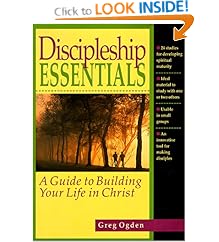 This session is being led by Greg Ogden:
Critical Questions:
1. What is your approach to making reproducing disciples of Jesus?
2. What do you think it takes?
3. What is the environment in which reproducing disciples are grown?
4. What ingredients are necessary?
Spiritual Growth Continuum:
Exploring Christianity –> Growing in Christ –> Close to Christ –> Christ-Centered
The Critical Journey by Janet Hagberg and Robert Guelich
1. What is the journey? 2. Where are you on the journey? 3. With whom are you journeying? 4. What is the next step for you?
The Biblical Model of Disciple-Making
I. Jesus called his disciples (Luke 6:12-13)
A. What were Jesus’ strategic reasons for focusing on a few?
B. Why not be satisfied with the increasing size of the crowds?
II. Paul’s Intergenerational Reproduction (II Timothy 2:2)
Paul –> Timothy –> Faithful Ones –> Teach Others
Conclusion:
Jesus’ and Paul’s model for discipleship was based on small groups of people – multiplying to others. This differs from the current common church method which depends on big group setting to disciple.
Ministry Based Strategy of Disciple-Making
I. The Primacy of Relational Context for Making Disciples
A. Program vs. Relational Approach
1. Discipling relationships are marked by intimacy, whereas programs tend to be focused on information.
2. Discipling relationships involve full, mutual responsibility of the participants, whereas programs have one or a few who do on behalf of the many.
3. Discipling relationships are customized to the unique growth process of the individuals, whereas programs emphasize synchronization and regimentation.
4. Discipling relationships focus accountability around life-change, whereas programs focus accountability around content.
B. A working definition of discipling: Discipling is an intentional relationship in which we walk alongside other disciples in order to encourage, equip and challenge one another in love to grow toward maturity in Christ. This includes equipping the disciple to teach others as well.
Discipleship takes a long time. Build slowly. Build solidly.
I hope that someday someone will write to me expressing their faith in our Lord, and that perhaps my obedience was somehow related to their growth.
Characteristics of Program:
Consumer Church: Offer many options and invite people to partake from the smorgasbord.
Made in crowds: We talk at people in groups and expect that something actually happened.
II. Multiplication: Empowering Disciples to disciple others
A. Frustration over multiplication: I was stuck
B. The characteristics of one-on-one method of discipling:
1. In the one-on-one, the discipler carries the full weight of responsibility for the spiritual welfare of another.
2. The one-on-one relationship sets up a hierarchy that tends to result in dependency.
3. The one-on-one limits the interchange or dialogue.
4. The one-on-one also creates a one-model approach.
5. Finally, the one-on-one model does not generally reproduce.
C. The characteristics of triads/quads
1. There is a shift from unnatural pressure to the natural participation of the discipler.
2. There is a shift from hierarchy to peer relationship.
3. There is a shift from dialogue to dynamic interchange.
4. There is a shift from limited input to wisdom in numbers. (Consider triads or quads of different generations)
5. There is a shift from addition to multiplication.
III. The Environment for Transformation: Creating the Hot House Effect
When we (1) open our hearts in transparent trust to each other (2) around the truth of God’s Word (3) in the spirit of mutual accountability, we are in the Holy Spirit’s hothouse of transformation.
Climatic Condition #1 – Transparent Trust
The extent to which we are willing to reveal to others those areas of our life that need God’s transforming touch is the extent to which we are inviting the Holy Spirit to make us new.
Stages of Trust Building: 1. Affirmation 2. Walking together in difficult times 3. Prayerful Listening 4. Mutual Confession
Climatic Condition #2 – Truth in Community
The Need for Truth (I Timothy 3:16,17): 1. We have lost the memory of Christianity 2. We need systematic instruction
Climatic Condition #3 – Life Change Accountability
Covenantal Accountability: A covenant is written, mutual agreement between 2 or more parties that clearly states the expectations and commitments in the relationship.
1. The Challenge of Radical Individualism
2. Disciples are under authority
IV. Necessary Elements for Making Reproducing Disciples
– A commitment to a biblical vision of multiplication: Do the Lord’s Work in the Lord’s Way
– A clear covenant of disciple-making: setting expectations
– An environment of Holy Spirit inspired transformation: Triads/Quads
– A transferable tool such as Discipleship Essentials or simply the Bible
– A means to keep the vision alive as generational reproduction occurs.
V. Practical Steps to creating a small, reproducible discipleship group
Step 1: Pray
Step 2: Make a personal invitation
Step 3: Tell them what is involved
Step 4: Review the Covenant
Step 5: Ask the disciple to prayerfully consider the invitation
Step 6: Inform them that there will be at least one other person joining you
Step 7: Set the first regular meeting and get started
Step 8: Guide the participants through the sessions
Step 9: Model transparency
Lots of information, stay tuned for more…
Breakout C – Finding and Launching New Leaders
Breakout lead by Dave Treat:
Workshop Goal – Learn to use a leadership assessment tool that will identify the readiness of each potential leader in your ministry and will clarify different training paths to help them move toward leadership.
Define – What do we want to reproduce?
– The reproducible life. “Follow me.” I Corinthians 11:1
– What is the role of the Small Group Leader? What do we want to see happen in our groups?
– Leading vs. facilitating. A leader facilitates in a direction to take the group somewhere.
– Exercise: Skill or Maturity?
Has a servant’s heart? Maturity
Has personal integrity? Maturity
Can plan a meeting? Skill
Has spiritual passion? Maturity
Can guide a discussion? Skill
Social intelligence? Skill
Spot – How do you spot your best candidates?
– Reproducible traits are observable. “We have heard.” “We have seen.”
– Harvest “low-hanging fruit”. Men and women who are “ready” to lead. Look for traits you want to reproduce (maturity, skills). Pizza principle – see who leads naturally.
– Nurture your saplings. People with potential. FAT people – faithful, available, teachable.
– Create opportunities to spot potential leaders. Announcements. Strategic events. Ask.
– Land Mines:
– Those who think they’re leaders.
– Those with personal agendas.
– Those who can lead elsewhere but are spiritually immature.
– Those who are unknown. (Are they currently in a small group?)
– HARVEST: Who do I know who might be a small group leader?
– NURTURE: Who do I know who with some help could be a small group leader?
Assess – What do they need to lead?
– Leadership Assessment/Training Matrix (hopefully I can post a diagram of this later)
Equip – Mature/Skilled: Vision
– The preferred future: changed lives. Potential leaders should be passionate about changed lives.
– Use resources.
– Make sure your goals agree.
– Do they get it?
Equip – Growing/Unskilled: Apprentice
– 80% of candidates.
– OTJ (on the job training): Apprentice learns by leading.
– Mentor: spiritual maturity; group skills.
– Take your time, but don’t overtrain.
Equip – Growing/Skilled: Disciple
– Short-term, intensive maturity building
– Planned and targeted spiritual growth
– Spiritual passion, servant hood, integrity
– Take your time: You can’t microwave maturity.
Equip – Mature/Unskilled: Turbo
– Short-term, intensive skill training
– A small group of apprentices
– Take your time: Learn community in community
– Leaders train each other. Have leaders lead the group for each other. Have other leaders give HONEST feedback. This is healthy.
– Turbo Training:
– Weeks 1 and 2: Knowing each other (60 min.); Lecture/Q&A – Basic META (60 min.); find out their story (light a candle and have them talk until the candle goes out).
– Weeks 3+: Leader of the day (rotate) (45 min.); debrief (15 min.); lecture/Q&A (60 min.); read Leading Life-Changing Small Groups.
Launch
– Take your time.
– Preparation vs. control
– Strategy depends on coaching resources
– You are not the Donald.
Terms:
– Apprentice – one who is learning to lead by leading.
– Turbo – a small group made entirely of apprentices.
– Coach – a leader of small group leaders.
Stay tuned for more later…
Breakout B – Removing and Restoring Leaders
Okay this looks like a “positive” subject. Rex Minor is the presenter:
– Resources when approaching this subject: Boundaries, Face to Face; Emotional Intelligence; The Peace Maker; Silos, Politics and Turf Wars; Unleashing the Power of Rubber Bands.
– There are many reasons for removing leaders: poor fit, incompatibility of vision, sin/moral failure, break of confidentiality, divisive behaviour, theological differences, health (mental/physical) issues, improper relationship with group members, lack of dedication.
– What is the one thing God wants from us in these passages (John 17:20-23, Phil. 2:1-4, 1 John 2:1-9)? UNITY! We want to be unified to God and to each other.
– One of the greatest enemies of unity is unresolved conflict – people don’t know how to get along.
– Confrontation – (latin) “to turn your face towards” Confrontation works best when it serves love.
– We have to have the right mindset first. Restoration must be our goal, not just removal. Realize that we are commanded to do this as a lover of God’s kingdom (Hebrews 10:24, 25, Proverbs 27:17). Spur – (greek Paracosmos) – “to come alongside and sharpen, stimulate, encourage, provoke others”
– Self Deception – There is a gap between who we are and who we think we are.
– Am I more loving this year than last year?
– We are all to be change agents for each other (I Thessalonians 5:11).
– Realize we are inviting another to come into the light so we all can live in peace, grace, and freedom (I John 1:5-7).
– Humility, humility, humility! We need a tone of grace, not a tone of the law.
– When we approach a leader with a concern, there tends to be two types of responses: driven by fear, driven by curiosity. Fear is the enemy of love – perfect love casts of fear.
– “We change when the pain of staying the same is greater than the pain of changing.”
– Leanne has been a change agent in my life – see no TV for a month challenge. This was ultimately a positive experience.
– In order to be good at leading anyone, you cannot give away what you do not posess.
– When we approach a leader we should confront (Matthew 18:15-17):
– Step 1: Engage in dialogue along with the person (vs. 15). Prepare your heart. Ask God to show you your heart in the matter before you dialogue. Pray diligently before the conversation. Be present and be aware of your presence – your body language, tone of voice, inflexion. Be gracious. Use kind words – practice them. Use notes if necessary. Be clear and specific about the offense. Stay on task – avoid deflection. Use I statements – I feel >>>> when you <<<<. Listen well. Listen very well. You may not have the answer. You may be wrong. Avoid oughts and shoulds. Explain how their behavior impacts the group. Do it face to face – not over e-mail (or other electronic means). Be willing to be uncomfortable. Proverbs 20:5. Be a person of understanding today. Be aware that you may have to admit fault. Go ahead and do it – admit you’re wrong. Give up your right to right. Matthew 7:5.
– Step 2: Go with 1 or 2 witnesses (vs. 16). Only 1 or 2, not 3 or 4 or more.
– Step 3: Tell it to the church (vs. 17). Church leadership not church. Plead with them to change.
– Step 4: Removal. We need to help them realize the seriousness of their sin. We need to make sure they don’t destroy community. We want to equip and protect the community. If you do Steps 1-3 properly, then Step 4 won’t happen that often.
– We should be doing this with each other all the time. God’s expects this kind of interaction all the time.
– Ordering Your Private World and A Resilient Life – book recommendations by Gordon MacDonald.
– It’s best to restore leaders in stages. Make sure they are mentored along the way. Get counseling. Look for teachable moments. Move towards the leader and not away from them. Don’t let them move into the darkness. Have a point person to help them navigate through the restoration process. When you’ve restored them, have a party to celebrate – like the Prodigal Son.
Stay tuned for more…
Breakout A – Leveraging Technology to Support Community
Blogging from the breakout led by Cynthia Ware:
– Technology is normative.
– The next generation is thinking about communication differently than my generation.
– http://thedigitalsanctuary.org
– Views every church as multi-site: bricks and mortar – clicks on the web.
– Many churches are starting Internet campuses.
– Every one of us has a sphere of influence surrounding our lives. Those spheres are migrating on-line.
– Communication is changing (Radio, Film, Newspapers, and TV) from single/few options to many, many options. From few to many to many to many.
– New communication is a circle. We want conversation. People want to converse; they don’t want to be lectured. People want to be part of a conversation. Back and forth communication is expected and necessary to move discipleship forward.
– Communication is changing: interactive, participatory, mobile, viral, wireless, transparent, viral, user generated, many to many, digital, free…
– Culture is changing: flattening economies, global, transparent, wisdom of crowds, mobile, crowd sourcing, in sourcing, viral, digital, post-modern, connected…
– Community is changing: relationship economy, glocal, in common, viral, mutual respect, micro-community, shared trust, shared values, electronic, Internet mediated, interest based, unboundaried, participatory, virtual…
– Christianity is spread virally.
– Digital communication (back and forth) allows people to feel connected not only to each other but to leadership.
– Church is changing: socially committed, missional, multi-ethnic, multi-site, iCampus, cell-driven, authentic community, transparent leadership, eco-aware…
– I could be an iPastor. (Whoa!)
– Not using technology is missing an opportunity.
– As stewards of Christ, we have a responsibility to redeem technology by getting involved on things like mySpace, etc.
– We are going to be buying “green” everything in the next 10 years. Why do we produce the church bulletin? Because we haven’t put it on line and because we haven’t stopped producing it (on paper).
– We need to be active aggressive learners.
– Not a lot of true discipleship can take place in a large crowd listening to a speaker.
– Leadership is changing: decentralized, interactive, participatory, life streaming, flattening, responsive, fluid, transparent, listening, engaging…
– Cells are changing: Or are they?
– I want to develop a more missional mindset to my spheres of influence. We are called to go and make disciples.
– I Chronicles 12:32 – “The men from Issachar understood what was going on at that time. They knew what Israel should do.”
– We should use an Exodus 18 model. Exodus 18:17-24. Ministry to a person is not based on facts; it’s based on truth.
– We’ve migrated. Many of us spend time online daily. The reality is that the sooner we adopt and adapt, the sooner we can be the influencers.
– If you start an online group for something you are passionate…you will be starting community.
– The point of all this communication is to create intimacy and connection with people.
– Check out: Kindle (online prayer), YouVersion (online Bible), Unifyer (online Community Hub).
– Some people to look up on the subject: Dave Anthold, Greg Atkinson, DJ Chuang, Tony Steward, Gene Wyrrick, The WareHouse.
– Look into reading Tribe.
Stay tuned for more…
Pre-Conference Coaching Forum Notes
Before the conference even started yesterday, I had the privilege of attending a coaching forum to talk about coaching strategies, tactics, and issues. The forum was led by some of the country’s top small group coaching strategists, Greg Bowman, Mike Hurt, and Dave Auda. Here are my notes:
-Every leader needs encouragement and support.
– Consider using the term “branching” instead of “launching” and “birthing.”
– We need people who are 100% focused on group life.
– Coaches should schedule out relational meetings to make sure they happen.
– When recruiting coaches, consider having people over for diner to eat, play Cranium, and talk a little about coaching. Don’t necessarily use this as an opportunity to ask them to coach, but instead to ask them to pray about coaching.
– Make sure that the structure serves the people and not the people serving the structure.
– Get the right mind set from your coaches.
– Coaches should do group visits to remind people that the group is part of the church and to keep a finger on the pulse of what’s really happening in group life. A coaches first group visit should be in a social setting.
– Jesus strategy from Luke 9:1-9 – JUST GO!
– Jesus strategy from Luke 10:1-23 – JUST GO!
– We need to have a missional mindset about our groups.
– People need to be aware of the lost people in their lives.
– Mosaic is doing something cool with their coaching strategy. They are teaming up 3 coaches to oversee a larger group of small group leaders. The team should provide a pastoral (care/spiritual development) role, a catalytic (connectedness) role, and an assimilative (vision to save the lost) role. This strategy minimizes burnout, minimizes blind spots, maximizes synergy of spiritual gifts and strengths, and is more fun!
– Coaches need to be in community!
– We have to be flexible.
– It’s not going to be the same formula everywhere.
– Don’t minimize the power of prayer.
I know this is somewhat of a hodgepodge, but I have to say that this forum was far more valuable than I expected. I am so excited to wrestle through some of this still.
Stay tuned…
Group Life Conference 2008 Session 3
I’m trying something new – blogging while listening to the speaker. Session 3 is titled What Stunts Community Growth led by speaker Will Miller. So here are my notes below:
The culture stunts community growth.
2 Facts about American culture:
a. Last year, 46 million Americans moved.
b. The average American watches 28 hours of television a week (not counting Internet).
These two facts demonstrate why Americans are timid, self reliant, and individually focused.
Questions for the audience: How many hours do you spend each week watching television? I think I watch 5-10 hours a week.
How many hours do you spend each week looking at a computer screen? I would say more than 25 hours (I work quite a bit on a computer – I’m on the computer right now.)
What is the total number of times that you have moved? I’ve moved5 times.

Refrigerator Rights (the title of his new book) – The term “refrigerator rights” refers to those who can, without asking permission, open the fridge in your home and make a sandwich—i.e. how many people you are really close to.
“Driving is the laboratory for American mood disorders.” This guy is funny. He went on with some driving stand-up comedy (you should know that he’s also a stand-up comedian).
We have to get over the fact that things in community aren’t always going to be comfortable. When we get together, our love for each other has got to trump the uncomfortableness of our differences. The questions above point to the actions in our country that perpetuate the problem. This is why group life ministry is so important. It is not going to be easy. We are swimming big time against our culture. The answer to the disconnectedness of our culture is community through small groups.
Stay tuned for more…
Group Life Conference 2008 – Session One
I am so thrilled to be back at the 10th annual Willow Creek Group Life Conference this week. Honestly with such a busy schedule (work, family, and church) lately, I have hardly had time to even think about the conference. After attending the first large group session this afternoon, I’m convinced this was just what I needed – not just for small group leadership at Christ’s Church of the Valley, but for me personally.
The session started out with a tremendous worship experience. At first, I was singing along focussing on the Willow experience. Somewhere along the way though, I was moved into true worship – focussing on God. I’ll be honest, it has been a while since I have really felt this connection.
I think this was a perfect lead in to John Burke‘s message – Why Community is Essential. John asked the question, “What is the centerline off which we need to build community?” He used passages from Luke and John to explain that there is only one thing that is necessary. That one thing is to listen to Jesus. Jesus said in John that we are to love each other as I have loved you. And apart from Jesus, we can do nothing.
If what we are doing is not connected to Jesus, it amounts to nothing.
For me, this was an important reminder. As we do group life at our church, we need to be centered on Christ. If we want to see people growing and connecting in our church, our groups ministry must be centered on Jesus.
In all the great stuff that John Burke shared today, this was what I needed to hear.
Stay tuned for more updates from Willow…