 Jon Stolpe

Jon Stolpe
Stretch Quote – Finish Strong (@RobinSharma)

Starting strong is good. Finishing strong is epic.
Robin Sharma
The past few weeks, I have been running hard. I’m not ready to give up, but I can feel fatigue tempting me to ease up on my effort.
This is the same feeling I had while running each of my three marathons. A marathon is 26.2 miles long. Around 20 miles into the race, it’s common for runners to hit the wall.
In life it can be the same way. Life is a marathon, and we start with the best of intentions, but we too often lose focus and energy before we reach the finish line.
Today, I want to remind you to finish strong. How you finish will build character in your life and will determine your legacy.
As we enter the final lap of 2015, I encourage you to keep going. Run through the finishing line. Finish strong!
What keeps you pressing on when you feel like giving up?
For more encouragement to finish strong, check out my book: On Track – Life Lessons from the Track & Field. There’s an entire chapter dedicated to finishing strong.


Election Day – How To Be A Politically Active Christian


Those who stand for nothing fall for anything.
Alexander Hamilton
Today is Election Day. Around the country, citizens are casting their ballots for the next leaders in their communities.
I’ve always had an interest in politics. We are so blessed to live in a country where we can take part in the selection process for our local, state, and national leaders. Voting is a right, a privilege and a responsibility.
Free speech is also one of the rights that we have in this country. Free speech gives us permission to defend our position on an issue or on a candidate. I’m thankful for this right. But I sometimes wonder if this right has gotten our country into trouble.
With the creation and rise of social media, everyone has a say. People’s thoughts and opinions are out there for everyone to read. Once it’s on Facebook or Twitter or once it’s published on a blog, it’s a permanent record for all to read. And it seems like everyone has something to say.
Maybe I’m forgetful of past election cycles, but it seems to be that more and more people are posting personal character attacks on Facebook and other social media outlets. Photo-shopped photos of candidates with disrespectful comments dominate my Facebook news feed. To be honest with you, it’s wearing me out. I wasn’t comfortable when friends and family attacked former president George W. Bush, and I’m not comfortable with the attacks on current president Barack Obama.
Sure, it’s okay to disagree with policies, budgets, and agendas of our leaders. But it needs to be done with respect. The other day, I was reading the Bible and a passage from Ecclesiastes 10:20 stuck out to me:
Do not revile the king even in your thoughts, or curse the rich in your bedroom, because a bird of the air may carry your words, and a bird on the wing may report what you say.
Today, it just doesn’t seem like people care about reviling or respecting our leaders. So how should we as Christians respond responsibly and respectfully?
4 Keys To Being A Politically Active Christian
- Pray for our leaders. Whether or not you agree with a particular political leader, we should pray for our leaders. Paul directs this in his letter to the Philippians:
I urge, then, first of all, that petitions, prayers, intercession and thanksgiving be made for all people — for kings and all those in authority, that we may live peaceful and quiet lives in all godliness and holiness. Philippians 2:1-2
- Don’t participate in the disrespect. Don’t add fuel to the social media fire by being disrespectful in your posts, comments, or conversations. In our country where free speech is our right, dialogue intelligently and respectfully with each other.
- Vote. This is your right, responsibility and duty. Let your voice be heard through your vote.
- Win, lose, or draw, live your life in a Christ-like manner. Whether “your” candidate wins or not, you have the opportunity to make a difference by how you choose to live your life. If you feel strongly about an issue like helping the poor, get involved by helping the poor. We don’t need our candidate in office in order for us to make a difference. We can make the most of each and every opportunity, and we can do so with respect. And we can still choose to love those who lead us and who debate with us – even if they disagree with us. (John 15:17)
What other suggestions do you have for Christians to participate responsibly and respectfully in the political process? Are you being respectful or are you adding to the clutter?
(Note: My article originally appeared at Wisdom Of A Fool.)
Top 10 STRETCHED Posts For October 2015


Here are the top posts from last month:
- 5 Ways To Represent Well
- How I Create The Images For My Blog Posts
- The Number One Way To Do What God Says
- How I Maintain A Positive Attitude (When Negativity Surrounds Me)
- Book Review: SELAH by Joseph Iregbu
- 5 Steps To Creating A Personal Success Plan That Works
- The Discipline of Transitioning Well – 4 Tips for Transitioning from One Event to the Next
- 5 Fears That Can Control Your Life and How to Overcome Them
- Ice Breaker – Excited For Life
- Ice Breaker – First Kiss
Which post was your favorite? What STRETCHED you the most in October?
If you are a blogger, what was your top post last month? Please feel free to share links.
Ice Breaker – Mischief Night


The trickster’s function is to break taboos, create mischief, stir things up. In the end, the trickster gives people what they really want, some sort of freedom.
Tom Robbins
Each week on The Stretched Blog, I ask an ice breaker question. The questions are designed to help us get to know each other here in The Stretched Community. I’ll provide my answer to the question here in the post, and then you can leave your response in the comments. While you’re in the comments section, see how others answered the ice breaker question.
(I’m always looking for Ice Breaker question ideas. If you have an idea, send me an email at jon@jonstolpe.com. If I use your question, I’ll give you credit and share your links.)
Tonight is Mischief Night. This is the night before Halloween when teenagers participate in acts of mischief in the neighborhoods. I never participated in Mischief Night as a kid, but I remember waking up Halloween morning to discover soap on car windows, eggs on houses, and toilet paper in trees. Pulling pranks on unsuspecting people can be fun (at least for the pranksters). Today’s Ice Breaker question is inspired by Mischief Night – the night of pranks.
Question: Have you ever pulled a prank on someone? Tell us about it in the comments. (If you haven’t pulled any pranks, have you ever been the target of a prank?)
My Answer: My biggest and best pranks took place on youth group retreats when I was in junior high and high school. My last year in 8th grade, I particularly remember pulling several pranks while our church youth group was on a winter retreat at Camp Johnsonburg in northwestern New Jersey. The best prank involved a fish, a toothbrush, and a cat.
One of my friends caught a dead sunfish out of the lake on the retreat campus. While the high school girls were out of their cabin, a few of us took advantage of the opportunity to pull a prank. We found one of the girls toothbrushes in the cabin, and we slid the toothbrush inside the fishes mouth. We quietly crept out of the cabin and waited for the girls to return to their cabin. While I don’t remember the outcome, legend has it that there was a cat waiting on the front porch of the cabin when the girls returned.
Answer this week’s ice breaker question by leaving a comment. I look forward to reading your response! (As always, feel free to share links.) And keep Stretching!
6 Ways To Reward Your Employees


Start with good people, lay out the rules, communicate with your employees, motivate them and reward them. If you do all those things effectively, you can’t miss.
Lee Iacocca
Rewarding employees appropriately is a key aspect of improving employee performance. It’s essential that employees are recognized for a job well done. Sometimes this recognition is tied to a monetary reward, and sometimes it’s necessary to find non-monetary methods for rewarding your team.
Inappropriate rewards could easily work against the overall performance of the business and it’s employees. Rewarding employees who don’t deserve could be argued as grace, but this kind of “reward” sends the wrong message to employees, and it sets teams up for mediocrity.
Appropriate rewards push individual performance to new levels, and they raise the bar on overall company performance. Here are a few reward types for you to consider as you seek to improve your team and company.
6 Ways To Reward Your Employees
- Thank You Note. Matt McWilliams wrote about the Thank You Revolution in his eBook available for free when you sign up at his blog. And I wrote a guest post for him titled, The Power of Gratitude. Rewarding employees should start with gratitude. A simple handwritten thank you note is all it takes many times tell employees that they’ve done well or done something that deserves recognition. Last week, I wrote to many of my direct reports to thank them for their hard work in bringing our fiscal year to a successful completion. These notes gave me an opportunity to specifically recall good things that my team members have done this year. One of my team members took time to write me back this week: “Thanks for the card. It means a lot.” His simple response affirms the power of a simple thank you note. Don’t underestimate the power of a simple thank you note.
- Department Meeting Shoutout. Let’s face it. It’s easy to get caught up in the regular business items in agenda of a standard office meeting. Make it part of your meeting agenda to recognize employees who have gone above and beyond the call of duty since the last meeting. Maybe an employee did something to wow a customer. Maybe they were key to a sale or project success. Honor them in front of their peers. It shows them their efforts are appreciated. It demonstrates to others in the office the type of actions and behavior worth following.
- Small Financial Reward Program. Our company set up a reward program which permits managers and fellow employees to recognize employees who have done something special. The rewards start at $25 and go up from there. A small reward of this nature is a great way to show family members how their loved one is appreciated. These rewards are often used by employees to take their spouses out to dinner or to purchase something for the home they wouldn’t have purchased otherwise. This may not be possible for your company, but it’s something worth considering if your company can swing it. A small financial reward of this nature rewards employees, and it encourages employees to do things which will benefit the company.
- Merit Based Increases. This is the time of year I decide on pay increases for my team members. I have a fixed amount to work with as dictated by my company. In order to reward high performers, it’s crucial I provide the higher merit increases to the employees who have earned it through their performance over the past year. There is a market fairness factor that plays into this decision. I am doing a disservice to my team though if I don’t reward team members based on their performance. If I decided to give everyone the same increase regarding their performance, I would not be sending a positive message that would improve the overall performance of the company.
- Incentive. Finding ways to provide incentives to employees can be a great way to promote desired behaviors and outcome. At our office our sales members are paid based on commission. They have a huge incentive to sell profitable projects. Our project managers receive an incentive bonus at the end of the year. The incentive is based on individual project slip along with a couple of other key performance indicators. And our management encouraged to work together towards overall business success as part of the management incentive program. Managing your payment program to make room for this kind of program can be a great way to enhance the overall performance of your team and your business.
- Special Assignment. When an employee does something good, it is often a sign they are ready for the next challenge. When a team members does well, give them the opportunity to try something different, something more challenging, and something that will draw attention to them in the future. When one of my team members does a great job on one of their projects, I like to assign them a high profile project or a special assignment. While this kind of reward will not immediately impact the paycheck, it will give your team member a chance to stretch, to grow, and to feel special. Sometimes this is the best reward!
I’m sure there are some other ways to reward employees. I’d love to hear your thoughts on the above list and your ideas for rewarding employees. Share your thoughts and ideas in the comments.
How do you reward your team members? How does your company reward its employees? Do you think rewards work? Why or why not?
For more great articles on this topic:
Stretch Quote – Greater Capacity (@BidemiMarkMordi)


The human spirit is like an elastic band. The more you STRETCH, the greater your capacity.
Bidemi Mark-Mordi
The other day, I discovered an old rubber band behind on the floor near the wall in my office. The rubber band had been there for a while. It hadn’t been stretched for a while, and it was actually brittle. I grabbed two sides of the rubber band, and I pulled my hands away from each other. The rubber band stretched a little, but it didn’t last. Within seconds, the rubber band snapped. It broke. Instead of a continuous circle of rubber, it turned into a curvy line of rubber. It was no longer useful, so I threw it in my trash can.
If you don’t use a rubber band, it becomes useless.
Stretching is important for our lives. We must keep stretching ourselves to maintain our usefulness and to help us grow to new limits.
How are you intentionally stretching yourself?
The Discipline of Transitioning Well – 4 Tips for Transitioning from One Event to the Next


Times of transition are strenuous, but I love them. They are an opportunity to purge, rethink priorities, and be intentional about new habits. We can make our new normal any way we want.
Kristin Armstrong
When my son was a toddler, he struggled when it was time to do something else like go to bed, take a bath, or get in the car. He was busy doing something else, and he didn’t like an abrupt end to what he was doing. After enduring several tantrums, my wife came up with a plan. She suggested we give Isaac a ten minute warning before it was time to do the next thing. This gave him the chance to finish up what he was doing, and it gave him a heads up that something else was coming. This strategy worked wonders in how Isaac handled transitions.
I was reminded of this the other day when I was talking with fellow youth leaders at our church. We were talking about being ready to interact with students at least ten minutes before our meeting starts. This requires me to put aside my thoughts from my previous appointments.
Too often, I abruptly move from one appointment on my schedule to the next without the opportunity to shift my mindset. If I’m going to practice the discipline of being present, I must learn to first practice the discipline of transitioning well. A solid plan for transition will help me make the most of my experiences before and after my schedule shifts from one thing to another.
Here are four tips for being intentional about your times of transition from one activity to the next:
4 Tips for Transitioning from One Event to the Next
- Give yourself a buffer between appointments. When I go from one thing directly to another thing, I don’t give myself an opportunity to transition well. Learn to build ten minute buffers into your schedule so you have time to shift your attention.
- Take notes to sum up your ending appointment. One of the reasons we struggle to transition is that we haven’t left our previous appointment in a place of closure. Our brains continue to process what we were just doing. During your time of transition, take a few notes to help you remember where things were left in case you need to return to this activity later. Use a journal, a note taking application for your phone or tablet, or a voice recorder to document how you are leaving things regarding your earlier appointment.
- Take time to consider the objectives for your upcoming engagement. If you fail to plan, you should plan to fail. Use the minutes before your next appointment to plan – to process the goals for what is ahead. For example, I should plan to interact with at least three students as I’m driving from my house to church for youth group. Considering your objectives gets your brain ready for the next appointment, and it helps you to be more effective when you get there.
- Make it a priority to make the most of every opportunity. When we fail to transition well from one activity to the next, we are missing out on making the most of the present experience. The discipline of transitioning well will minimize the possibility of wasting our time.
As I head into a busy day at the office, these are tips I need to remember TODAY.
How would your world be different if you made the decision to practice the discipline of transitioning well? How has intentional transition made a difference in your life?
The Number One Way To Do What God Says


We must allow the Word of God to confront us, to disturb our security, to undermine our complacency and to overthrow our patterns of thought and behavior.
John R.W. Stott
I want to do the right thing. Don’t you?
I spend my “free time” in the car or on the treadmill listening to podcasts, so I can learn more. On my nightstand, I have a few leadership books. I listen to 150 podcasts every week, and I read through (or skim through) over 330 blogs whenever there is a new post.
I stand by the saying “Leaders are readers.”
But I think I sometimes take it too far.
When I say I want to do the right thing, I mean this:
- I want to be a great husband.
- I want to be a great father.
- I want to be a great employee.
- I want to be a great boss.
- I want to be a great leader.
- I want to be a great friend.
- I want to be a great teammate.
- I want to be a great giver.
- I want to be a great person.
I don’t want to mess up when it comes to these areas of my life (and other areas). I’m a perfectionist. Unfortunately, I get it wrong if these are my pursuits.
I want to be a great Christ-follower. If I can get this right, the other things should take care of themselves. If I’m serious about this proclamation – if I’m serious about wanting to be a great Christ-follower, I should do what God says.
What is the number one way to do what God says?
If you want to do what God says, you have to know what God says.

“But the man who looks intently into the perfect law that gives freedom, and continues to do this, not forgetting what he has heard, but doing it – he will be blessed in what he does.” James 1:25
“How can a young person stay on the path of purity? By living according to your word. I seek you with all my heart; do not let me stray from your commands. I have hidden your word in my heart that I might not sin against you.” Psalm 119:9-11
If I want to follow Christ, I have to start by digesting God’s Word. Spending time in God’s Word does not happen with a closed, dust-covered Bible on the coffee table. It happens when I open it up, when I study it, and when I take time to chew on it. Only then can I truly do what God says.
If you want to do the right thing, start with God’s Word.
When was the last time you spent time studying God’s Word? How do you make the most of time reading The Bible? What has God recently been teaching you through His Word?
Ice Breaker – Excited For Life
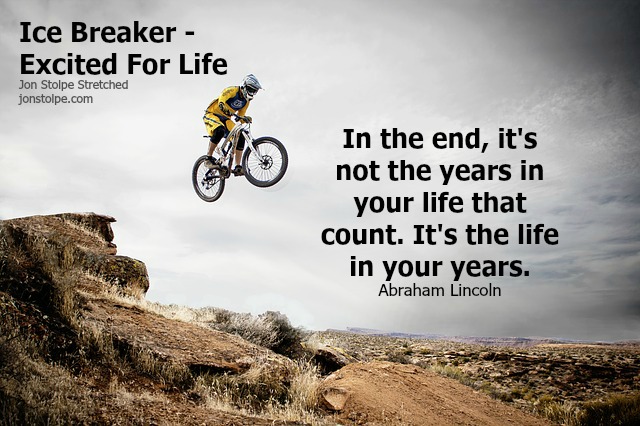
In the end, it’s not the years in your life that count. It’s the life in your years.
Abraham Lincoln
Each week on The Stretched Blog, I ask an ice breaker question. The questions are designed to help us get to know each other here in The Stretched Community. I’ll provide my answer to the question here in the post, and then you can leave your response in the comments. While you’re in the comments section, see how others answered the ice breaker question.
(I’m always looking for Ice Breaker question ideas. If you have an idea, send me an email at jon@jonstolpe.com. If I use your question, I’ll give you credit and share your links.)
Too often, we lose our zeal for life as we allow the pulls and pressures of life to weigh us down. This week’s Stretched Ice Breaker is meant to re-inject some energy back into your life.
Question: What gets you excited about life?
My Answer: The best way for me to answer this question is to create a list. Here are some of the things that get me excited about life:
- Spending time with my wife
- Watching my kids use their talents and discover their passions
- Helping others succeed
- Writing a killer blog post
- Serving in Guatemala
- Speaking to people
- Running
- Reading an inspiring book
- Watching playoff baseball (especially when the Cubs or the Phillies are on the field)
- Checking things off my to-do-list
- Connecting with my mastermind group
- Being in community with people who positively stretch me
- Watching a good movie
- Going on vacation
- Going to work
- Going to church
Going to the dentist- Learning something new
Answer this week’s ice breaker question by leaving a comment. I look forward to reading your response! (As always, feel free to share links.) And keep Stretching!
10 Ways To Get the Most out of the Performance Management Process


Don’t lower your expectations to meet your performance. Raise your level of performance to meet your expectations. Expect the best of yourself, and then do what is necessary to make it a reality.
Ralph Marston
It’s that time of year again!
This week, I’m in the middle of the performance management process for my team members. This is an annual opportunity to provide feedback to my team members on their performance over the past year. I could be easy to rush through this process which is required by my company. I could simply write a couple of sentences about each team member and move on to the next year.
Taking this approach doesn’t do my team members any favors, and it doesn’t help my team or the company get better. A well thought out and carefully executed performance review can be the bedrock of success for your team and your company.
In today’s post, I offer ten ways to get the most out of the performance management process. This is written from a managers perspective; however, this is a great reference for those who don’t manage direct reports. After reading today’s post, you may want to suggest that your supervisor start this type of performance management process for you. You may simply want to tweak what is already happening at your job.
Whether you are a manager of direct reports or not, I hope you’ll find this list helpful in understanding ways to get better. Success doesn’t happen by accident. Success happens by being intentional, and this list offers suggestions – no, essentials – for being intentional with the performance management process.
10 Ways To Get the Most out of the Performance Management Process
- Start with regular one-on-one meetings. It’s important to meet with your employees on a regular basis. These meetings provide an opportunity to touch base on performance issues and other business and non-business related items. You can read about the power of one-on-one meetings in a guest post I wrote for Matt McWilliams. This year I started having monthly one-on-one meetings with my team, and it’s been helpful for my team members and for me.
- Set performance targets. It’s critical that employees have SMART targets. Targets should be specific, measurable, attainable, realistic, and timely. At the beginning of each year, I sit down with my team members to set targets. These targets align with our overall business objectives, and they also provide opportunities for individuals to grow personally. (For more details on why employees should set performance targets, click here.)
- Quarterly review progress towards targets. It shouldn’t be a surprise at the end of the year when doing a performance evaluation. I sit down with my employees once a quarter to review their progress in achieving their targets. Doing this once a quarter provides an opportunity for my team members to make performance corrections that will help them meet or exceed their targets.
- Get feedback from others. I encourage my team members to ask for feedback from their peers. And I get feedback from other managers and supervisors regarding the performance of my team members. Before completing the annual performance management process, I meet in a roundtable meeting which helps to calibrate my overall assessment. This meeting also provides extra insight into developmental action items I might want to suggest to my team members. (To read a different angle on the discipline of getting feedback, click here.)
- Take time to write an honest and detailed assessment. When I write evaluations for my team members, I want them to be fair, well-thought, and encouraging. Writing this kind of assessment takes time. I schedule time to carefully review the past year of activity. I look at notes from my past one-on-one meetings. I review previous results from the quarterly updates. And I take into account comments shared by my fellow management team members. A written record provides employees a tangible document to review as they seek to grow and improve.
- Meet with employee to review results. At the end of the year, it’s important to let your employees know how they have done. Feedback provides information necessary to help them improve. Feedback also keeps them doing the right things.
- Remember the good things. Make sure you praise your team members for the good things they have done throughout the year. A pat on the back goes a long way towards encouraging the right behavior.
- Create a development plan correcting issues. As managers, it is our responsibility to help our team members succeed. We have to give our team members help in getting better. The performance review process is the perfect time to help employees get better.
- Discuss career progression essentials. Most employees want to know what it will take for them to get tho the next level in their career path. It’s important to talk regularly to employees about their plans for the future. What are their goals for the next 5 years or 10 years? What do they need to do in order to be ready for the next steps? These are questions that will help you help them. Are their expectations realistic? How can you help them? The performance review process provides an opportunity to discuss essentials for career advancement.
- Do it again. It may seem repetitive, but you have to do it over and over and over again. Doing this for only one year does not demonstrate a long-term interest in the performance of an employee. Repeated year after year is essential to a successful performance management process.
How has the performance management process helped you succeed? What would you add to the list above? What do you need to do differently in order to improve your own performance management process?
Here’s an interesting article to go along with this post: